mEducation: Building Resilient Education Systems

mEducation: Building Resilient Education Systems in the Philippines and Beyond

Through mEducation, parents and teachers are teaming up to ensure no student is left behind. Watch our video to see how this phone-based remedial program is bridging gaps and helping students thrive, wherever they are.

Watch Video


Green dots in a wave pattern


Overview


The mEducation program aims to improve math skills by delivering math problems via text and providing weekly 20-minute phone tutorials tailored to individual learning levels.

Already lagging in international assessments, the Philippine education sector faced even greater challenges exacerbated by the COVID-19 pandemic, widening the learning gap, particularly for students from disadvantaged households. Stemming learning loss and strengthening learning recovery, particularly in households that lack resources, require innovative and cost-effective strategies that can reach as many families as possible.

In 2021, IPA, in partnership with Youth Impact and the Department of Education (DepEd), implemented a phone-based math program focusing on foundational operations called mEducation. The mEducation program combines elements of Teaching at the Right Level (TaRL) and one-on-one tutoring through text messages and phone calls, aligned with DepEd’s priority in strengthening numeracy programs to help learners develop foundational skills and master competencies needed at their level. Given that more than 90 percent of households in the Philippines have at least a basic cellular phone (PSA, 2020), the program fits the local context.
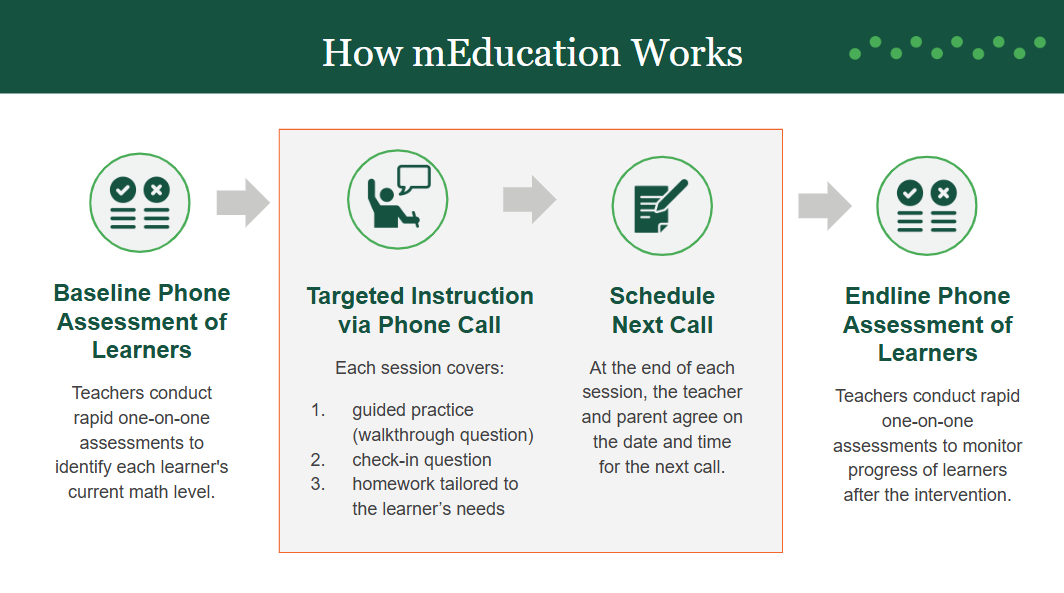
 

Infographic describing how mEducation works - baseline phone assessment of learners, targeted instruction via phone call, scheduling next call, and endline phone assessment of learners

Green dots in a wave pattern

From Evidence to Impact

The program, developed by Youth Impact, demonstrated positive outcomes when first implemented in Botswana. To examine its scalability, researchers conducted a randomized evaluation in five countries, with IPA leading the evaluation in the Philippines. The program was implemented for 3,492 students, randomly assigned to one of three groups: a comparison group that did not receive the program, a group that received both phone calls and SMS, and an SMS-only group. Additionally, the program was implemented by both the Philippines Department of Education (DepEd) and IPA to assess its feasibility for government implementation and evaluate whether the program delivery had an impact on its effectiveness.

The full mEducation program (SMS + phone calls) in the Philippines boosted children’s learning by 40 percent. The Philippines was among the countries with the biggest impact among the five countries. Government-led implementation of mEducation was equally effective as when IPA implemented it. The program has an average cost of approximately USD 12 per child, yielding 3.4 learning-adjusted years of schooling (LAYS) per USD 100 spent, making it a cost-effective solution to improve children’s educational outcomes.


Green dots in a wave pattern

Partner with Us


IPA Philippines is seeking implementation partners—such as governments, NGOs, and universities—who are interested in implementing the mEducation program and helping us scale and expand the program to reach more learners who need remediation support. Feel free to download our partnership materials or complete our Partner with Us form to learn more about mEducation.

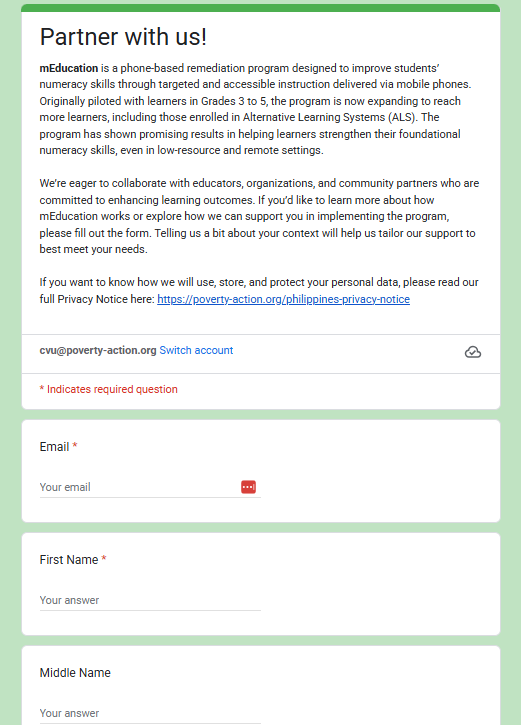
Screenshot of Google Form open in web browser

Partner with Us Form

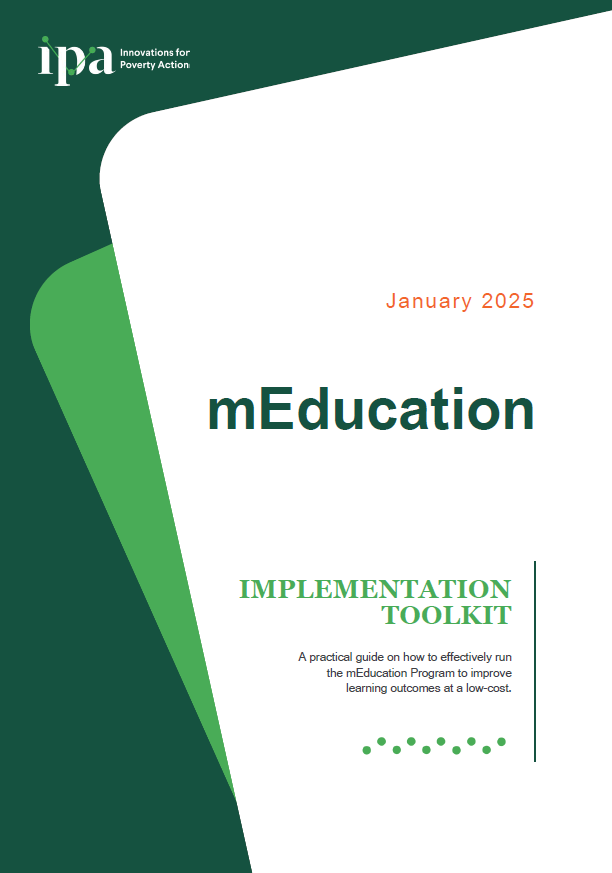
Screenshot of front cover page of toolkit

Implementation Toolkit

Screenshot of quick guide for teachers PDF

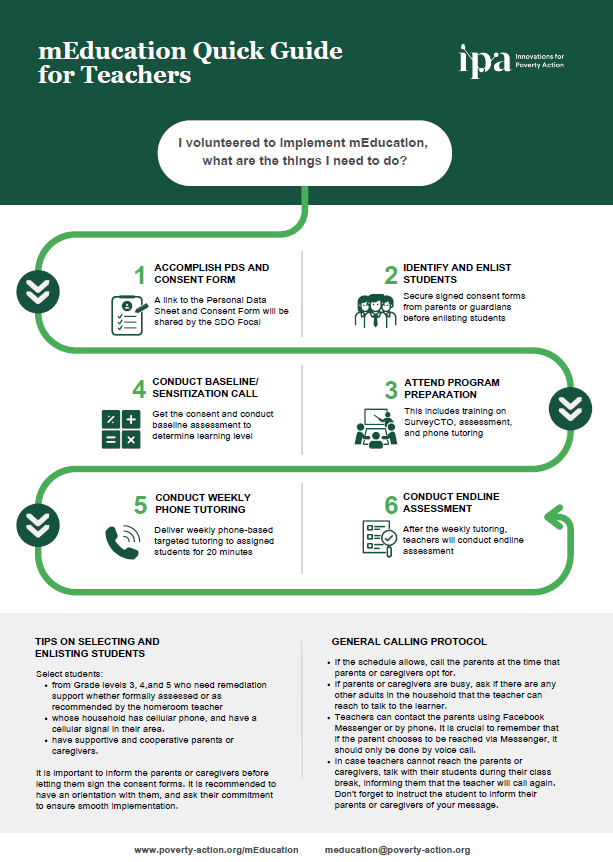
Quick Guide for Teachers

Screenshot of quick guide for focals PDF

Quick Guide for Focals

Green dots in a wave pattern

Scaling the mEducation Program

Icon of a teacher standing pointing to a chalkboard in front of three students in a classroomIcon of a teacher with a pointer in one hand and an open book in her other handIcon of a school buildingIcon of a government building representing Schools Division Offices

14,297

1,708

570

20

Learners

Teachers

Schools

SDOs


After establishing mEducation as an effective program to improve learning outcomes, IPA started working with schools that expressed interest in implementing it. The goal is to reach more students while maintaining program fidelity. As the program expands, IPA will follow a strategy that starts with a demonstration phase and ends with the program’s ownership transfer to the schools allowing them to implement mEducation with minimal technical support from IPA.

Phase 1: Test and buy-in. IPA will provide full technical support to implement the program, including systems setup, training, and monitoring. Once schools have gone through Phase 1, they move up to the next phase.

Phase 2: Shared monitoring. IPA will support setting up systems and with the training, while program implementation will be co-monitored with school principals or math coordinators. We recommend schools do at least two rounds of program implementation before moving to the next phase.

Phase 3: Technology transfer. IPA will still provide support in systems setup, but partner Schools Division Offices (SDO) will lead the training and monitoring of program implementation.

wave

Delivery Models

DepEd Teachers

We are partnering with DepEd Schools Division Offices to scale mEducation. Participating schools must enlist at least four teachers from Grades 3–5 to implement phone-based tutoring, integrating the program into existing systems for broader reach and sustainable impact.

University Pre-Service Teachers

To expand the reach of the mEducation program without increasing the workload of DepEd teachers, we are partnering with universities to engage education students as mEducation tutors. These pre-service teachers offer phone-based support to elementary learners, gaining experience while improving student outcomes.

NGO Tutors

We are collaborating with NGOs that have the capacity to implement and manage the mEducation program in their communities. Leveraging their established local networks and experience in program delivery, these NGOs provide valuable support in extending the program’s reach and ensuring that more learners receive consistent, high-quality guidance.

Green dots in a wave pattern


How Teaching at the Right Level (TaRL) Complements mEducation

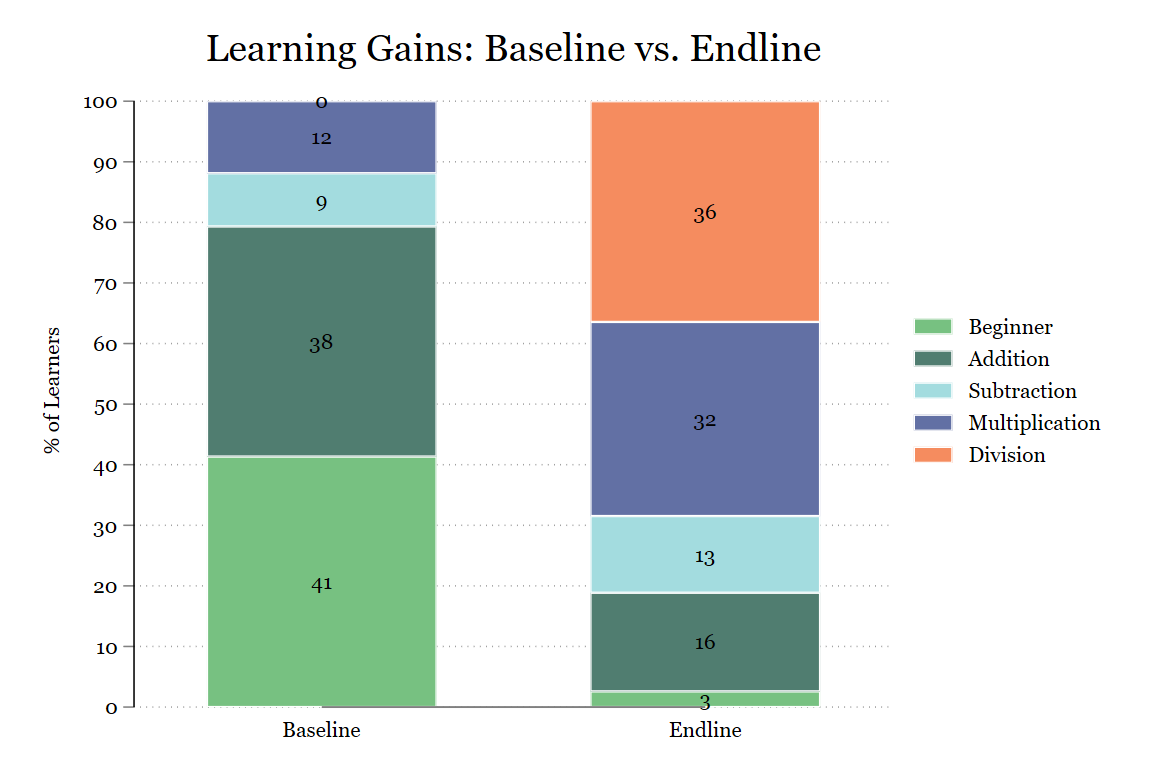
Stack bar graphs comparing learning gains from baseline to endline

TaRL is an approach that assesses children's learning levels and groups them accordingly, rather than by age or grade, to better target instruction. TaRL complements mEducation by providing practical, hands-on support to partner Schools Division Offices (SDOs) that are unable to implement mEducation due to limited network connectivity.

In late 2025 to early 2026, we piloted the TaRL program with SDO Butuan City and SDO Puerto Princesa, engaging 31 teachers and reaching 387 students. The pilot resulted in a 38-percentage-point reduction in innumerate learners at the endline and a 36-percentage-point increase in learners achieving division-level proficiency.


Partners

    Department of Education


    The Department of Education (DepEd) formulates, implements, and coordinates policies, plans, programs, and projects in the areas of formal and non-formal basic education. It supervises all elementary and secondary education institutions, including alternative learning systems, both public and private; and provides for the establishment and maintenance of a complete, adequate, and integrated system of basic education relevant to the goals of national development.

    Since 2015, IPA has been a key partner of the Department of Education in generating evidence through rigorous evaluation of programs and building the monitoring and evaluation (M&E) capacity of staff.

    Youth Impact

    Youth Impact logo

    Youth Impact is an international evidence-based, youth-led organization that designs, implements, and evaluates cost-effective programs in health and education to improve children's lives at scale in Africa and beyond. Founded in 2014, Youth Impact is committed to sharing evidence to inform policies and promote evidence-based practices worldwide, applying entrepreneurial approaches to address social sector challenges and driving meaningful change for young people everywhere.

    Since 2021, IPA and Youth Impact have been collaborating on mEducation, where Youth Impact provided research and technical support in setting up the required systems to implement mEducation and assisted in training the teacher. Youth Impact, while scaling mEducation in other countries, is committed to continuing the collaboration with IPA to scale mEducation in the Philippines.

IPA Team

IPA Team

Policy and Project Development Manager

Karisha Anne Cruz

Karisha supports IPA Philippines in steering project development initiatives, overseeing policy outreach work, stewarding relationships with key partners, including engaging with key partners in governments, NGOs, foundations, and multilateral aid agencies.

Read Full Bio

Senior Research Associate

Nastasha Brigitte Kuan

Nastasha is a Senior Research Associate at IPA Philippines. She currently works on the scale-up implementation of the mEducation program and the Teaching at the Right Level program.

Read Full Bio

Senior Policy and Project Development Associate

Criss Anne Mallari

Anne supports IPA Philippines in policy and project development work.

Read Full Bio

Senior Research Manager

Rene Marlon Panti

Rene (Jepoy) is managing the Philippines Socioeconomic Panel Survey (PSPS), a 20-year panel study, and leading the scaling of mEducation, a program that delivers simple math instruction via mobile phones.

Read Full Bio

Field Manager

Michelle Ann Santos

Michelle is a Field Manager for IPA Philippines, focusing on the mEducation Project.

Read Full Bio

Senior Research Associate

Jerrean Segarra

Jeq Segarra is a Senior Research Associate for IPA Philippines. She has worked on financial inclusion projects such as the Interoperability Project and the Consumer Protection Research Initiative.

Read Full Bio

Research Associate

Clarice Kimberley Tee

Clarice is a Research Associate for the mEducation scale-up in the Philippines.

Read Full Bio

Policy and Project Development Manager

Karisha Anne Cruz

Karisha supports IPA Philippines in steering project development initiatives, overseeing policy outreach work, stewarding relationships with key partners, including engaging with key partners in governments, NGOs, foundations, and multilateral aid agencies.

Read Full Bio

Senior Research Associate

Nastasha Brigitte Kuan

Nastasha is a Senior Research Associate at IPA Philippines. She currently works on the scale-up implementation of the mEducation program and the Teaching at the Right Level program.

Read Full Bio

Senior Policy and Project Development Associate

Criss Anne Mallari

Anne supports IPA Philippines in policy and project development work.

Read Full Bio

Senior Research Manager

Rene Marlon Panti

Rene (Jepoy) is managing the Philippines Socioeconomic Panel Survey (PSPS), a 20-year panel study, and leading the scaling of mEducation, a program that delivers simple math instruction via mobile phones.

Read Full Bio

Field Manager

Michelle Ann Santos

Michelle is a Field Manager for IPA Philippines, focusing on the mEducation Project.

Read Full Bio

Senior Research Associate

Jerrean Segarra

Jeq Segarra is a Senior Research Associate for IPA Philippines. She has worked on financial inclusion projects such as the Interoperability Project and the Consumer Protection Research Initiative.

Read Full Bio

Research Associate

Clarice Kimberley Tee

Clarice is a Research Associate for the mEducation scale-up in the Philippines.

Read Full Bio