




The Challenge
In response to significant learning gaps exacerbated by pandemic-related school closures, the Philippines Department of Education (DepEd) is prioritizing strategies to strengthen students' foundational math skills. A survey conducted by DepEd teachers of the schools participating in the study reveals the following statistics: 59 percent of students in Grades 3-5 cannot perform basic mathematical operations, and among 5th graders, fewer than 10 percent can complete subtraction problems. As DepEd implements the Academic Recovery and Accessible Learning (ARAL) Program as part of its learning recovery plan, there is a critical opportunity to integrate evidence-based interventions that can help elementary students build strong math foundations.
About TaRL
Teaching at the Right Level (TaRL), developed by Indian education organization Pratham, has demonstrated success in improving basic foundational reading and math skills through its innovative approach of grouping students by learning level rather than age or grade. The program combines four key elements: learning-level assessments, targeted instruction, engaging educational materials, and robust implementation monitoring. Since 2001, multiple randomized evaluations in India and Africa have found that the TaRL approach is successful, with students often acquiring more than a year’s worth of math skills in a single program cycle.1
TaRL in the Philippines
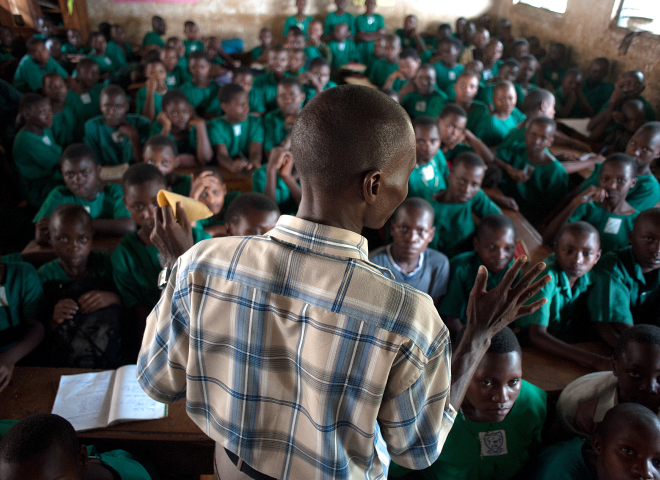
Building on this evidence and the promising results of another targeted instruction program like mEducation (globally known as ConnectEd), IPA is collaborating with the Department of Education (DepEd) and Youth Impact to adapt and evaluate the TaRL approach in public schools in the Philippines. The Schools Division Offices (SDOs), the DepEd field offices, were closely involved in planning, selecting schools, and adapting the program to fit local contexts while aligning with DepEd policies. The program operated as daily 30-minute to one-hour sessions, in addition to the regular class schedule, and served 865 students across eight schools in Luzon and Mindanao.
Teachers assessed students' math skills and organized them into groups based on learning levels rather than grade or age, and engaged them in interactive activities designed to strengthen foundational math skills. The program followed a six-week cycle with three key assessments: initial evaluation for group formation, midpoint assessment for instructional adjustments, and final assessment to measure progress, with students advancing to more challenging material upon achieving 70 percent mastery.
Results
The results show that the TaRL program improved students' math skills. After six weeks, over 85 percent of students learned at least one new basic operation, while the percentage of students able to perform any math operations increased from 5 percent to 59 percent. After three weeks of TaRL instruction, 27 percent of students could subtract, multiply, or divide, increasing to 65 percent after six weeks—compared to 5 percent during the initial assessment. Students gained an average of 1.4 math levels, with the strongest results in Digos City and Caloocan City (1.5 levels). These results match previous TaRL programs where students gained between 1.1 and 1.7 school years of learning in one cycle, suggesting the Philippines pilot was as effective as established programs elsewhere.
Beyond learning impacts, the program maintained strong participation in schools, with 97 percent of enrolled students completing the full six weeks. Teachers found TaRL activities easy to manage and noticed students became more enthusiastic as they experienced success. They appreciated TaRL's play-based approach, which helped students grasp math concepts using simple, low-cost materials. Many teachers started using these techniques in their regular classes, suggesting they found real value in the methods. However, teachers recommended smaller class sizes (maximum 15 students), more dedicated training time, and better coordination with school schedules to avoid conflicts with other activities.
Policy Impact and Implications
Based on these positive results, Youth Impact, IPA, and DepEd plan to scale TaRL across the Philippines in 2025.
Sources
1 “Teaching at the Right Level to Improve Learning.” 2018. The Abdul Latif Jameel Poverty Action Lab (J-PAL). 2018. https://www.povertyactionlab.org/case-study/teaching-right-level-improve-learning.
Implementing Partner


