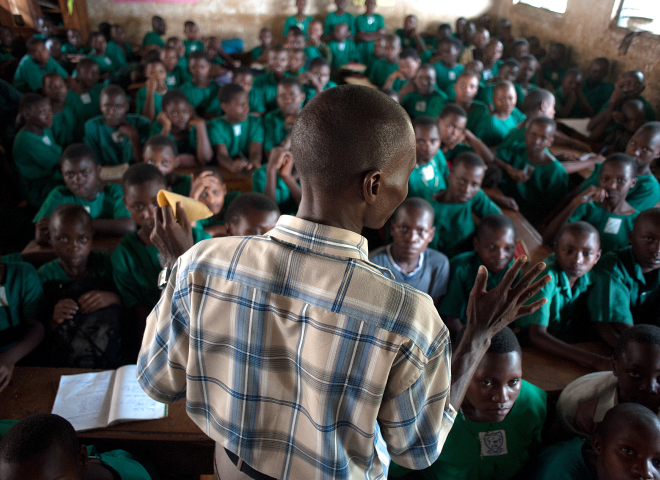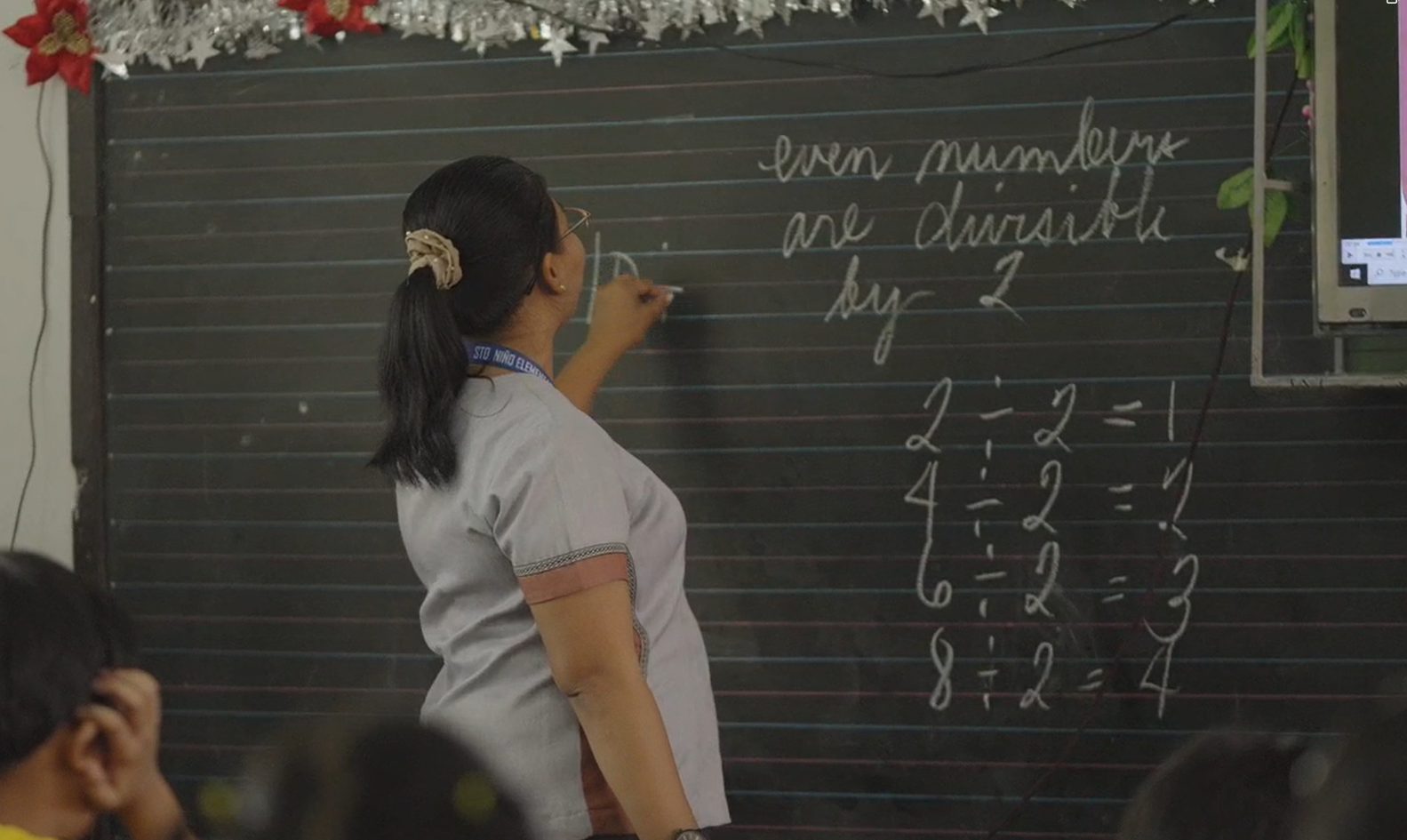
An mEducation teacher guides elementary school students through a math lesson. © 2024 IPA
The Philippines faces a learning recovery challenge. Even before the COVID-19 pandemic, Filipino students were performing poorly in international assessments (PISA 2018, 2022), revealing deep and widespread struggles with foundational learning. These challenges were exacerbated by the pandemic, which caused prolonged school closures and limited access to in-person instruction.
Children in remote and underserved communities were hit the hardest, as many lack the connectivity or support systems needed to continue learning from home. The country’s vulnerability to natural disasters continues to hinder education delivery, particularly in rural and disaster-prone areas where schools are often damaged or inaccessible.
In response, the Department of Education has made foundational learning and recovery a national priority. Through initiatives like the Academic Recovery and Accessible Learning (ARAL) program, DepEd is investing in evidence-based strategies to close learning gaps and support students most in need.
mEducation, a cost-effective, globally recognized phone-based tutoring program that delivers targeted math lessons through phone calls for 20 minutes, aligns closely with these goals. In the Philippines, Innovations for Poverty Action (IPA), in collaboration with the Department of Education (DepEd) and Youth Impact, led an impact evaluation of the program at the height of the school closures due to the pandemic. The results were compelling: children’s foundational math skills improved by 40 percent, at an average cost of just $12 per student. By delivering targeted instruction through basic mobile phones, the program offers a low-cost, high-impact solution that fits the realities where connectivity remains a challenge, and the need for flexible, remedial support is urgent.
Our Approach: Partnering to Learn and Adapt
From the outset, our strategy has centered on close collaboration and continuous learning. After presenting promising evidence on mEducation’s effectiveness to DepEd, IPA began working with School Division Offices (SDOs), DepEd’s field offices responsible for implementing national education policies at the local level, to continue implementing the intervention post-pandemic.
Through these partnerships, interested SDOs and schools joined orientation sessions to understand the program’s goals and approach. Participating teachers then receive structured training on phone-based tutoring and SurveyCTO, a mobile data collection tool used to monitor implementation in real time. To support and motivate teachers, the program also provided incentives including service credits, certificates of recognition and completion, and communication allowances.
These efforts focused not only on implementation, they were designed to generate learning for both IPA and our partners. Working alongside Youth Impact, we conducted A/B tests, to explore how mEducation could be made more cost-effective and better aligned with the government’s priorities. For example, we tested different approaches to supporting teachers: comparing online briefings versus instructional support delivered via text messages, as well as the use of Facebook Messenger audio calls versus mobile phone calls to determine what worked best in the local context.
These helped IPA and Youth impact refine the program for scale, improving efficiency without compromising the impact. At the same time, our partners in DepEd gained valuable insights on what it takes to deliver low-cost, personalized instruction within the public school system, including how to mobilize teachers, reach learners remotely, engage with parents and caregivers actively, and manage implementation across different school settings.
Our Impact: Consistent Results across Implementation Rounds
Since the initial pilot in 2021, mEducation has moved from a proof of concept to a growing learning recovery strategy, with three (3) subsequent rounds of implementation for learning and improvement. Each round consistently delivered encouraging results, reinforcing the program’s ability to help children master foundational numeracy with only a few hours of instruction.
In March 2024, 265 teachers across 90 schools delivered phone tutoring to 1,015 students. Before the program, 56 percent of these students couldn’t solve a single basic math operation. After only 8 weeks, the share of students unable to perform basic math operations dropped to 15 percent. The share of students who could solve division problems more than tripled, from 2 percent to 17 percent.
In November 2024, results were equally compelling: the share of learners who could not solve any operation dropped from 28 percent to 6 percent, while the share of students who could solve division problems increased from 11 percent to 36 percent.
In summer 2025, building on this momentum, three SDOs implemented the program during the summer break, integrating it into their local remediation efforts. This marked mEducation’s widest reach yet, with 2,560 learners tutored by 361 teachers across 156 schools. After the 4-week cycle, the share of learners unable to solve any basic math operation decreased from 39% to 0%, while those able to solve division problems increased from 0% to 23%. These results align with previous rounds, demonstrating similar patterns across different settings and timelines.
Scaling Success: The Puerto Princesa City and Zamboanga Sibugay Model
Because of its strong evidence base and low-cost delivery, mEducation has gained traction within DepEd. At the national level, DepEd has expressed its support for the program. It is now being integrated into key national policies such as the ARAL program, and a formal Memorandum of Agreement is being developed to support nationwide scale-up.
At the regional and division levels, mEducation is operational. IPA has signed Memorandum of Understanding with nine DepEd Field offices to support implementation. Many of these divisions have taken ownership, allocating budgets, training teachers, and even leading program monitoring.
Nowhere is this local leadership more evident than in the division of Puerto Princesa City and Zamboanga Sibugay, under the leadership of Schools Division Superintendents, Laida Mascareñas, and Virgilio Batan, respectively. In these divisions, mEducation is now a division-wide initiative. With strong commitment from the SDOs, the program will now be implemented across all schools in the divisions. Both divisions have committed their own funds to provide communication allowances for teachers, making the program both sustainable and scalable.
Despite common challenges such as mobile signal limitations, teacher workload, and limited resources, SDO Puerto Princesa City and Zamboanga Sibugay demonstrate what’s possible when local champions believe in the solution. Their experiences offer models for how mEducation can scale successfully in other divisions across the country.
What’s Next
mEducation continues to scale nationwide to reach more learners in need of remedial education, especially those frequently affected by school disruptions. At a time when the Philippines urgently needs scalable, proven solutions to address its learning crisis, mEducation offers a practical way forward. It’s affordable and rooted in evidence. Most importantly, it’s built to reach the children who need it the most, whether they’re in remote areas, recovering from school closures, or falling behind.
In addition to DepEd, other partners are joining the effort. The Ministry of Basic, Higher, and Technical Education (MBHTE) in BARMM is launching mEducation as part of its flagship program focused on literacy and numeracy. Universities like Ateneo de Zamboanga University are piloting a model where pre-service teachers act as tutors, gaining practical experience while helping children learn. Non-Government Organizations like Save the Children are adapting mEducation in their own community programs.
mEducation is also exploring new frontiers, including reaching Alternative Learning System (ALS) learners who need flexible options to continue their education.
With DepEd’s strong support and a growing network of partners, mEducation is no longer just a promising idea. It’s becoming a nationwide movement: one phone call, one math problem, and one child at a time.
You can read more about these efforts here.