















Can Community Monitoring Improve Health Service Delivery in Uganda?

Header Block
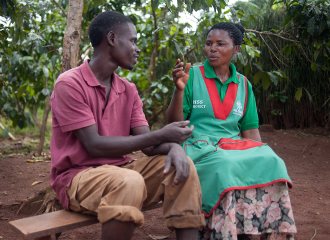
In this Image A community meeting in Uganda to discuss health center performance. © Doug Parkerson

The Challenge

Citizen accountability interventions—where communities are supplied with information about public service performance and mobilized to demand improvements—have become a growing strategy for addressing challenges in state service delivery across low- and middle-income countries. When citizens are informed about service shortfalls and organized to act on that information, frontline providers may respond by exerting greater effort and improving the quality of services they deliver, creating a direct link between community demand and provider behavior. Rigorous evaluations have found this approach to work in some contexts across sectors, though evidence overall has been mixed,1 creating a need for more research about the conditions under which it works.

Citizen accountability may offer promise in the health sector, where the gap between what frontline providers could deliver and what communities actually receive is both large and consequential. In Uganda, rural health facilities at the time of this study experienced understaffing, irregular drug supplies, and limited oversight. Moreover, just 45 percent of households seeking care reported visiting a government-run health center. Evidence from a decade earlier suggested that community health monitoring could be effective, with strong improvements in child mortality and immunization rates.2 However, whether these results would hold as Uganda’s health, socioeconomic, and political conditions evolved remains an important open question. 

The Program

The Accountability Can Transform (ACT) Health initiative was implemented by a consortium of civil society organizations coordinated by GOAL Uganda, an international humanitarian organization. The program delivered had three components:

Citizen Report Cards: Citizen Report Cards were provided to health centers and included information about health services in their service area, including people’s knowledge of their rights and responsibilities; utilization of the various services offered at the health center; perceptions of the quality of these services; and satisfaction with the health care they received. For most outcomes, the health center data was presented alongside district averages as a comparison.

Mobilization: Facilitators organized community meetings at which the report cards were presented and discussed. Participants developed action plans identifying concrete steps community members could take to improve local health service delivery. Parallel meetings were held separately with health center staff to review their own report cards results and develop corresponding action plans.

Interface Meetings: Health center staff and community representatives were brought together to discuss their respective action plans. In these meetings, both parties made commitments toward improving health outcomes. Implementing teams made three follow-up visits every six months to review progress on these commitments.

The Evaluation

In collaboration with IPA Uganda, researchers conducted a randomized evaluation to measure whether the ACT Health intervention improved health service delivery outcomes among rural communities and health facilities. The study involved 187 health centers serving 7,288 households across 16 districts. Health centers were randomly assigned to the following groups:

  • Full ACT Health Intervention
  • Citizen Report Cards only
  • Interface Meetings only
  • Comparison

After 8 and 20 months, researchers measured whether citizens increased their monitoring of health workers, whether providers improved the quality of care they delivered, and whether those changes ultimately reduced child mortality.

Results

The ACT Health intervention produced no measurable improvement in the majority of outcomes it was designed to affect. However, provider treatment quality and patient satisfaction modestly improved, notably in communities with the lowest pre-intervention levels of development and highest child mortality rates, where the intervention was also associated with reductions in child mortality.

The improvements in treatment quality were not due to community pressure but rather the intervention's information exposure directly shifting provider behavior. Specifically, health workers who may have felt monitored and motivated by learning how their facility compared to others were less likely to have drug stockouts, more likely to give patients privacy during examinations, and more likely to clearly explain diagnoses.

As for why the community monitoring did not work, researchers cited collective action problems, low expectations of government responsiveness, and limited citizen efficacy in monitoring and sanctioning frontline workers as key challenges. They also suggested that these issues were likely compounded by the political constraints around grassroots organizing in the country.

The results overall suggest that citizen accountability may not be uniformly effective to improve service delivery, even when a highly similar previous intervention was. This poses implications for scaling programs, notably that when and where evidence is generated may matter as much as the intervention itself.

Sources

1. Keefer, Philip, and Stuti Khemani. "Mass media and public education: The effects of access to community radio in Benin." Journal of Development Economics 109 (2014): 57-72.

Mogues, Tewodaj, Bjorn Van Campenhout, Caroline Miehe, and Nassul Kabunga. "The impact of community-based monitoring on public service delivery: A randomized control trial in Uganda." World Development 172 (2023): 106374.

Banerjee, Abhijit, Rema Hanna, Jordan Kyle, Benjamin A. Olken, and Sudarno Sumarto. "Tangible information and citizen empowerment: Identification cards and food subsidy programs in Indonesia." Journal of Political Economy 126, no. 2 (2018): 451-491.

Fiala, Nathan, and Patrick Premand. Social accountability and service delivery: Evidence from a large-scale experiment in Uganda. Mimeo, 2017.

2. Björkman, Martina, and Jakob Svensson. "Power to the people: evidence from a randomized field experiment on community-based monitoring in Uganda." The Quarterly Journal of Economics 124, no. 2 (2009): 735-769.


Implementing Partners

GOAL Uganda
HEPS Uganda Logo
KRC Uganda logo
MUCOBADI logo

Funding Partner

UKAID