With shrinking budgets and rising displacement, the international community needs better evidence on what actually works to improve outcomes for the nearly 120 million forcibly displaced people worldwide. In 2023, we pledged to help close this evidence-to-action gap through the Global Refugee Forum’s Multistakeholder Pledge on Economic Inclusion and Social Protection (EISP). Two years later we are excited to share how far we’ve come.
As a convening partner of the pledge, IPA committed to connecting policymakers, practitioners, and donors with evidence they can use to improve displacement response. Through IPA and J-PAL’s Displaced Livelihoods Initiative (DLI), we promised to support at least 20 rigorous impact evaluations and related projects on sustainable livelihoods for displacement-affected populations by the 2027 Global Refugee Forum.
Coming out of the EISP stocktaking event in December, we are proud to say that we have far surpassed our 2023 commitments. We are now implementing and/or funding over 50 impact evaluations and related research projects while working to get this evidence into the hands of decision-makers.
New Contributions to Evidence for Improving Displacement Response
DLI-supported research is already answering important questions. Last year, an evaluation of the International Rescue Committee’s ReBUiLD program in Kampala, Uganda revealed that cash grants improved outcomes for refugees and microentrepreneurship. Business mentorship showed mixed results when compared to cash alone, with positive effects for refugee men but negative effects for a subset of refugee women entrepreneurs. The IRC is now using these findings to refine their mentorship approach while scaling up cash grants.
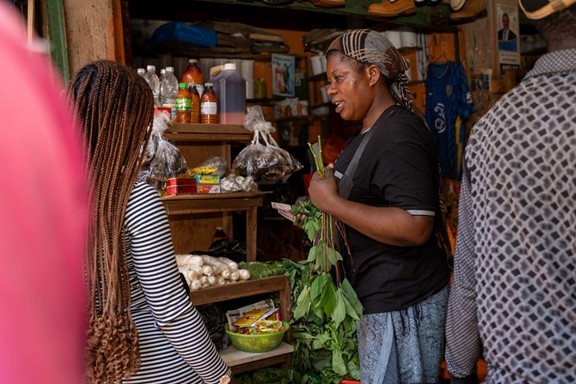
Racheal Chibalama, one of the recipients of the €525 microenterprise grant, is serving a client at her grocery store in Kampala. Chibalama invested her grant to increase the stock of local dishes to cater to her predominantly Congolese customers. PHOTOS BY NATHAN TIBAKU/IRC. 2024.
Over the next two years, results from DLI-funded projects will continue expanding what we know about refugee programming, shedding light on key questions across our five priority areas: rights and regulations, wage employment, entrepreneurship, social cohesion, inclusion and norms, and resilience. This work is already providing insights on the impact of programs and policies on economic and social integration, aid cuts, skills certification, business development, re-integration, and land tenure of displaced populations and the communities that host them.
We are particularly prioritizing studies that can inform key policy windows. In Ethiopia, we are partnering with the government’s Refugees and Returnees Services on two groundbreaking projects: one evaluating the expansion of the right to work for refugees, and another assessing the social and economic impacts of including refugees in a large-scale public works program. This represents the first systematic evidence on how different policy instruments affect economic, employment, and inclusion outcomes for displaced populations at scale.
In Kenya, studies focusing on public attitudes toward progressive refugee policies aim to provide insights for the operationalization of the Shirika Plan and help us understand the impact of a reduced aid environment. In Uganda, we are supporting research on how refugees are adapting to aid cuts and what can be done to mitigate their effects.
We are committed to expanding and investing in the work of individuals with lived experience of displacement and local expertise. Of the over USD 5.1 million that we have invested in research projects , USD 3.1 million has gone to research teams with lived experience of displacement. In addition, 55 percent of our full and pilot studies are evaluating programs run by governments, community-based organizations, and refugee-led organizations. We are excited to build on this momentum with Round V funding opening this year.
Partnerships for Evidence Generation and Use
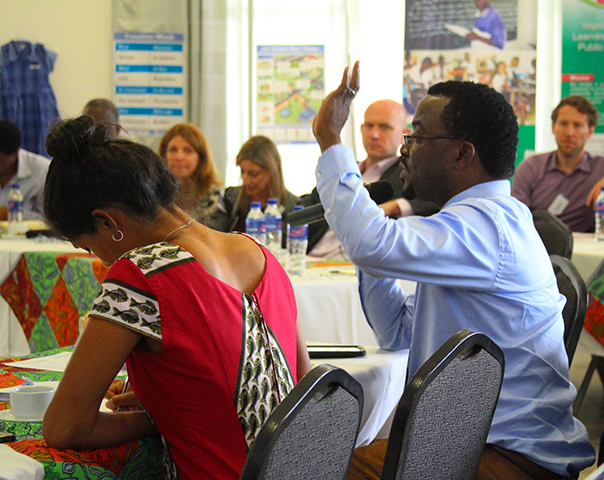
Research only matters if it reaches the people who can use it. Over the last two years, IPA and J-PAL have hosted a series of research incubators around the world, bringing together humanitarian and displacement actors to design evaluations of their programs and providing participants with a practical foundation in impact evaluation design. After the incubators, teams can be matched with researchers and are offered continued project development support through IPA country offices.
We are also actively engaging with the broader displacement evidence community. The Forced Displacement Working Group, led by the University of Pennsylvania and Center for Global Development, brings together policymakers, practitioners, and researchers to share new findings and identify collaboration opportunities. In September of last year, our team traveled to Sanremo for the first in-person edition of the UNHCR/World Bank Joint Data Centre on Forced Displacement’s Marketplace on Forced Displacement Research to discuss how government-academic partnerships can increase evidence-informed policymaking. As our funded projects have results, DLI is looking forward to hosting more events over the next few years to better connect the evidence to key stakeholders.
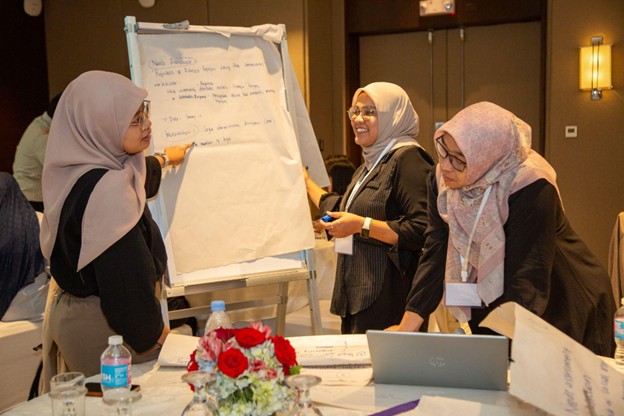
A team from a humanitarian organization during a workshop at the Humanitarian Action and Displacement Response Research Incubator in Manila. ©2025, J-PAL
How to Stay Up to Date on IPA’s Displacement Evidence
Want to keep up with the latest displacement evidence? In April 2025, IPA and J-PAL launched the Displaced Livelihoods Webinar Series to share ongoing and completed displacement-related studies. We have already featured research on the psychological impacts of refugee employment in Cox’s Bazar, emerging insights from the ongoing Syrian Refugee Life Study in Jordan, and findings from the IRC’s Re:Build program in Uganda.
Sign up for our mailing list here to stay up to date on new and emerging evidence on strategies to improve displacement response.