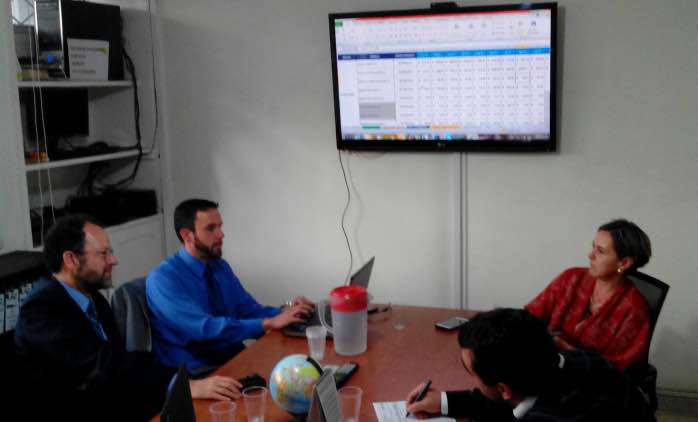
In collaboration with the National Productivity Center (CNP) and IPA Colombia, researchers conducted a randomized evaluation to measure whether individual or group-based consulting improved management practices, employment, sales, and profits among auto parts firms in Colombia. In the short term, both approaches improved management practices, and group consulting also produced significant gains in employment, sales, and profits. After 10 years, the impacts of individual consulting were hard to measure, while firms that received group consulting were more likely to survive, have higher employment, and have 50 percent higher sales and profits.
The Challenge
Small and medium enterprises (SMEs) in low- and middle-income countries (LMICs) face persistent gaps in management quality that constrain their productivity, employment growth, and capacity to compete in international markets. In Colombia, firms in the auto parts sector exhibited management practices typical of its manufacturing sector more broadly, with widespread weaknesses in logistics, human resources, finance, marketing, and production planning. Existing evidence points to a strong causal link between management practices and firm performance, with better-managed firms more likely to survive, grow, and expand into export markets.1
Management consulting has emerged as a promising intervention for improving firm productivity, by helping firms diagnose weaknesses and implement structured improvement plans. Research has shown that consulting can produce significant gains in management practices and firm performance.2 However, individual consulting is considerably expensive for firms, raising questions about cost-effectiveness and scalability. Group-based consulting offers a lower-cost alternative that may also generate additional benefits through peer learning and knowledge sharing among firms. However, an open question remained as to which type of consulting would produce the strongest impacts over the long run.
The Program
Colombia’s technological extension program, launched in 2012, offered management consulting to auto parts firms with the aim of improving production practices and competitiveness. Consulting was delivered by specialists from the National Productivity Center (CNP) and covered five operational areas: logistics, human resources, finance, marketing and sales, and production. All participating firms first received a diagnostic assessment in the second half of 2013, in which CNP consultants evaluated each firm’s existing practices across these five areas and produced a suggested improvement plan.
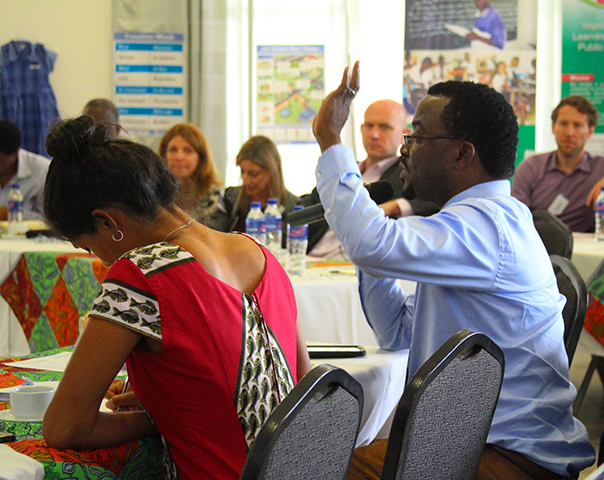
Two types of consulting were available to participating firms. Individual consulting consisted of 500 hours of one-on-one advisory support, at a cost of approximately USD 28,950 per firm, with consultants working directly with relevant staff in each operational area to implement the improvement plan. Group consulting consisted of 408 hours of support at a cost of approximately USD 10,500 per firm, with CNP consultants working simultaneously with small groups of three to eight firms from the same region. Sessions focused on topics common to the improvement plans of multiple firms in the group and were held at local facilities, bringing together staff responsible for the relevant operational area from each participating firm.
The Evaluation
Researchers conducted a randomized evaluation in Colombia to measure the impact of individual and group-based management consulting on auto parts firms. The intervention involved 159 firms, which were randomly assigned to receive individual consulting, group consulting, or to serve as a comparison group that received the initial diagnostic assessment only.
Primary outcomes, including management practices, employment, sales, profits, value-added, and production, were measured one year after the intervention. Researchers then used administrative records to track the same firms for up to a decade to assess whether early gains persisted over time and translated into broader improvements in firm performance and export activity.
Results
One year after the program ended, both individual and group consulting had a positive impact on firms’ management, as practices improved by 8 to 9 percentage points including monitoring key performance indicators, strategic goal-setting, and financial planning. Three to four years following the program, group consulting continued to show gains in employment, sales, profits, and value-added while the individual consulting showed smaller but insignificant improvements.
Tracking firms over eight to ten years revealed that the early gains from group consulting were not only sustained but grew over time. The long-term impacts of the individual consulting were less clear, with imprecise estimated effect sizes about half of those of the group consulting. Group-consulting firms were 11 to 13 percentage points more likely to survive than comparison firms, with the strongest effects for firms with the weakest management practices a decade earlier. Among surviving firms, employment rose by 28 percent, annual sales by 55 percent, and annual profits by 48 percent. These gains were in part due to an improvement in management practices and a 10 percentage point higher likelihood of exporting. In qualitative case studies conducted by IPA Colombia, firms reported that the group consulting enabled them to benchmark their operations against peers, to reflect on common challenges, and to form long-term working relationships.
Overall, given the sustained impacts over ten years and at one-third the price of individual consulting, group consulting offers a promising approach for supporting SME growth in settings where firms may be unable to access or self-organize such services on their own.
Read more about the ten-year impact of group consulting in this World Bank Blog.
Sources
1, 2. Bloom, Nicholas, Benn Eifert, Aprajit Mahajan, David McKenzie, and John Roberts. "Does management matter? Evidence from India." The Quarterly journal of economics 128, no. 1 (2013): 1-51.
Iacovone, Leonardo, William Maloney, and David McKenzie. "Improving management with individual and group-based consulting: Results from a randomized experiment in Colombia." The Review of Economic Studies 89, no. 1 (2022): 346-371.
Bruhn, Miriam, Dean Karlan, and Antoinette Schoar. "The impact of consulting services on small and medium enterprises: Evidence from a randomized trial in Mexico." Journal of Political Economy 126, no. 2 (2018): 635-687.
Implementing Partner
June 09, 2026
Double your impact by supporting IPA today
For a limited time, a generous anonymous donor will match online donations up to $50K. Donate today to double your impact while helping provide steady, sustainable support to IPA.