Preventing SME Default through Loan Stabilization: Evidence from Minibus Drivers in South Africa
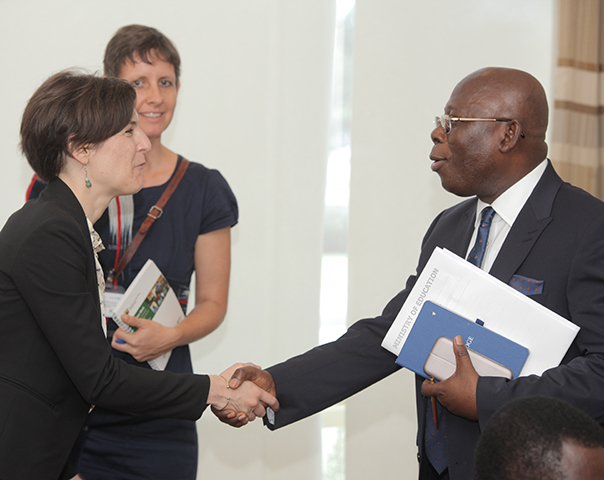
Feb 2025. Pictured (L to R) - Employee of financier, Jon Zinman (co-PI), Christopher Eaglin (co-PI), Minibus taxi owner.
Funded by IPA’s Consumer Protection Research Initiative and in partnership with a large publicly traded lender, researchers are conducting a randomized evaluation in South Africa to measure whether a novel “auto-stabilizer loan” with real-time contract flexibility for minibus taxi operators can reduce defaults, support firm resilience, and limit borrower distress.
The Challenge
Over 70 percent of small and medium enterprises (SMEs) globally depend on debt for financing,1 making them particularly vulnerable to cashflow disruptions from political, economic, and environmental shocks. While household debt restructuring has received significant academic attention, much less is known about how to support SMEs facing financial shocks and macroeconomic uncertainty. This study addresses two core questions: How do dynamic contracts affect upfront investment incentives, and do they reduce debt stress during shocks? These questions are particularly prescient in South Africa among minibus taxi operators, who rely on vehicle financing to sustain their businesses.
The Evaluation
In partnership with a large publicly traded lender, researchers are conducting a randomized evaluation in South Africa to measure whether a novel “auto-stabilizer loan” with real-time contract flexibility for minibus taxi operators can reduce defaults, support firm resilience, and limit borrower distress.
The study includes approximately 3,000 minibus taxi loans issued over the past five years in South Africa. Researchers will randomly assign eligible routes in the country, with half receiving the intervention and the other half assigned to the comparison group.
Routes in the intervention group will be eligible for a payment reduction if a shock occurs, determined by an overall decline in total driving volume over the previous month. When triggered, eligible borrowers will receive a 50-75 percent payment reduction for three to six months, achieved through loan term extension. Each borrower can receive only one modification during the 12-month intervention window. Borrowers will be informed in advance that their contracts will adjust automatically if a shock occurs on their route.
For a limited time, a generous anonymous donor will match online donations up to $50K. Donate today to double your impact while helping provide steady, sustainable support to IPA.