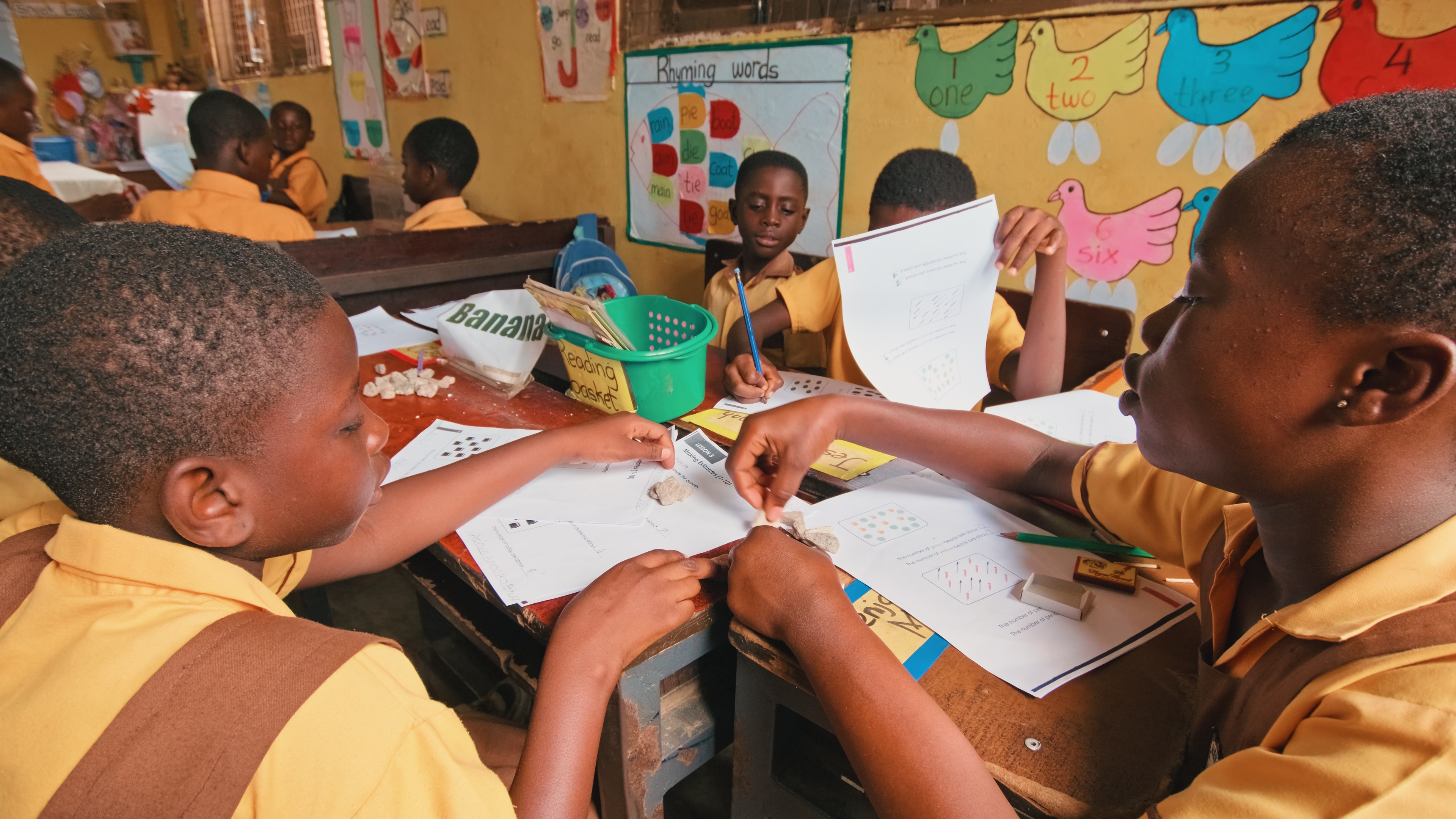
School children in Ghana engaging in class activities under the Differentiated Learning program
Getting from a successful pilot to national implementation is one of the toughest challenges in development. The problem is rarely the intervention itself. It is the gap between research conditions and the complex, resource-constrained realities that government systems operate within.
Bridging this implementation gap requires more than handing over an instruction manual. It demands strengthened government capacity, implementation fidelity, and adaptation to real-world constraints. Two cases from Ghana and Sierra Leone illustrate some patterns that hold more broadly about what it takes to move from evidence to impact at scale.
Supporting Implementation Fidelity as Governments Take the Lead
Implementation fidelity, ensuring that an intervention is delivered as designed, is one of the most persistent challenges in scaling. Without it, the improvements in outcomes that these interventions showed during the pilots aren't implemented. To scale up an intervention, the government faces the challenge of ensuring that all actors implement the project as designed.
In Ghana, scaling a proven Differentiated Learning (DL) program, also known as targeted instruction, required sustained investment in teacher support from the start. DL groups pupils by learning level rather than grade to deliver instruction tailored to students’ foundational skills. The origins of DL in Ghana date back to the Teacher Community Assistant Initiative (TCAI), a pilot study implemented between 2010 and 2013. Findings from the study demonstrated the potential of DL but also highlighted a key challenge: teachers required stronger management support to implement the approach consistently. Building on these findings, IPA, researchers, UNICEF, and government partners evaluated whether increased management engagement could improve implementation fidelity through the Strengthening Accountability to Reach All Students (STARS) program. The Ministry of Education incorporated research findings into its implementation of Differentiated Learning, which is now scaling to 10,000 primary schools over five years.
At scale, ensuring consistent implementation remained the central challenge. IPA shared lessons from STARS to inform the MoE's rollout, working alongside them to develop teaching and learning materials, deliver teacher refresher trainings, and strengthen coaching and mentoring. IPA also conducted school monitoring audits to verify implementation fidelity, triangulate self-reported practices with classroom observations, and capture real-time feedback on teacher motivation and resource adequacy.
IPA used the scale-up process to test and refine what drives effective implementation. A randomized evaluation conducted with the Ghana Education Service (GES), UNICEF, and researchers compared in-person and digital teacher training models. Without any refresher training, only around 12 percent of schools were actively implementing DL. In-person refresher training significantly improved fidelity and raised student English test scores, demonstrating that ongoing, hands-on support is essential to translating training into classroom practice.
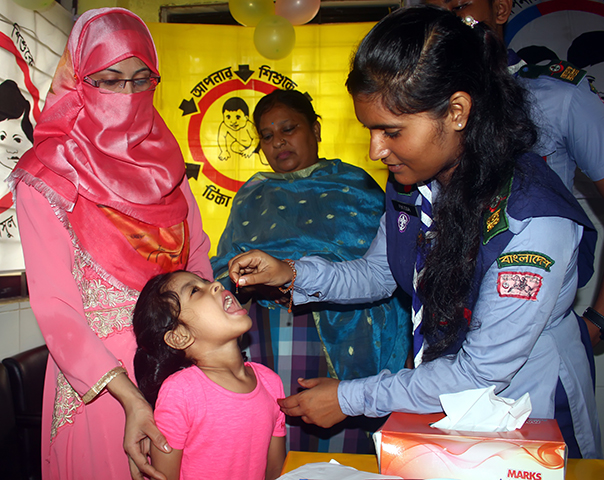
In Sierra Leone, IPA is helping the Ministry of Health understand what it takes to run a proven intervention without losing its impact. The intervention itself is a social signaling approach in which children receive colored bracelets at key vaccination milestones, creating visible community signals that incentivize timely immunization completion. A randomized evaluation found this approach increased the share of children receiving timely and complete vaccination up to the first measles dose by 13.3 percentage points and complete vaccination by age one by nine percentage points, with effects persisting through age two.
As the Ministry of Health now scales the program, IPA and a research team led by Anne Karing is running two parallel studies: a randomized evaluation to test whether the intervention remains effective when several core project functions are transitioned to ministry ownership, and a process evaluation across 75 clinics in three additional districts. The process evaluation will assess how the program is being implemented, document what is working and what is breaking down, and understand how clinic staff and communities are experiencing the transition to government ownership at scale. The study will address two questions that will directly shape how the government runs the program: whether the Ministry's cascade training model is sufficient to replicate impact, or whether more intensive clinic-level support is needed; and what format and content of training most effectively prepares health workers. The findings will give the Ministry an evidence-based blueprint for structuring implementation support within routine government systems.
Building Government Ownership From the Start
Many development programs fade away once external support ends because government ownership was never truly established. Genuine government engagement must begin during the pilot phase, not after.
In Ghana, securing buy-in from GES and collaborating closely with government partners proved essential to improving implementation fidelity during STARS. When government stakeholders have ownership over interventions integrated into their existing systems, accountability for faithful implementation increases at every level. As GES now scales differentiated learning to 10,000 of Ghana's lowest-performing primary schools through GALOP, that ownership is paying dividends. While planning the DL rollout, GES established a working committee with representatives from the Ministry, UNICEF, and IPA to oversee implementation, monitoring, and learning. This approach reflects the Ministry’s ownership of the program, ensuring that partners can identify critical implementation activities and sustain the program long after external technical assistance ends.
In Sierra Leone, IPA worked with the Ministry of Health to integrate the social signaling bracelets directly into the Ministry of Health's vaccine supply chain while still conducting the evaluation, demonstrating the Ministry’s early commitment to owning and sustaining the intervention. Rather than waiting until research was complete, IPA handed over this critical component early, working collaboratively with the Ministry to gradually strengthen the system. The goal is clear: when the evaluation concludes, the Ministry will have not just a proven intervention, but a scale-ready supply chain and the skills to manage it independently. This collaborative approach extends to ongoing refinement. IPA holds regular feedback sessions with District Health Management Teams to review monitoring data and develop solutions to implementation challenges. IPA is also co-creating comprehensive toolkits covering training materials, supply chain frameworks, procurement guidance, and communications strategies that will support national scaling in Sierra Leone.
Staying Flexible When Timelines and Priorities Shift
Anyone who has worked on scaling government programs knows that things rarely go as planned. External shocks disrupt timelines, policy priorities shift, and political leadership changes. The key is staying flexible without losing sight of what the program is trying to achieve.
Ghana's DL rollout faced multiple disruptions. COVID-19 closed schools and caused changes to the academic calendar, which affected rollout timelines. Political transitions at the Ministry also caused delays. A two-week teachers' strike affected national monitoring activities. Rather than viewing these as obstacles, IPA supported GES to first scale the approach in 235 UNICEF-supported schools, providing a testing ground for different strategies before the broader GALOP expansion. This phased approach allowed for refinement based on real-world feedback and ensured the 10,000-school rollout would be as effective as possible from day one.
In Sierra Leone, the suspension of USAID operations in early 2025 represented the most significant disruption to the program's scale-up. IPA had relied on USAID for the majority of implementation funding, and the sudden loss of this support exposed the fragility of depending on a single foreign government donor. This experience raises important questions about how to build more sustainable financing models for this type of work. Compounding this challenge, the Ministry of Health's decision to introduce a new malaria vaccine in 2024 also changed IPA's plans. The number of required visits in a child's first year jumped from six to ten, significantly increasing the burden on caregivers. Rather than proceeding with the original plan, IPA and the Ministry delayed the start of the intervention to align with the malaria vaccine introduction. The intervention design was adapted to assess the potential of the bracelets to increase timely uptake and completion of not just the routine immunization schedule, but also the new malaria vaccine, ensuring the intervention remained relevant to the Ministry's evolving priorities.
Looking Forward
The cases from Ghana and Sierra Leone show that the path from pilot to scale is neither straightforward nor guaranteed. Sustaining implementation fidelity requires ongoing investment in training, monitoring, and hands-on support, not a one-time handover. Government ownership has to be built during the pilot, so that ministries can run and adapt programs independently when external support ends. And when disruptions hit, the programs that survive are those with enough flexibility to adapt without losing what made them work in the first place. When these pieces come together, pilots can grow into full-scale, sustainable programs that deliver results.