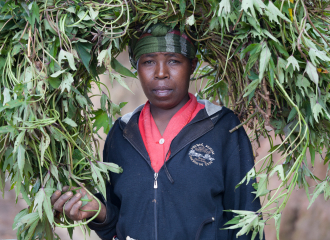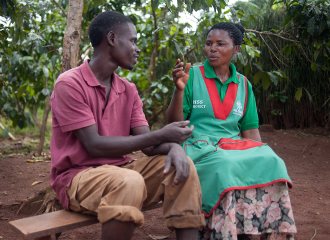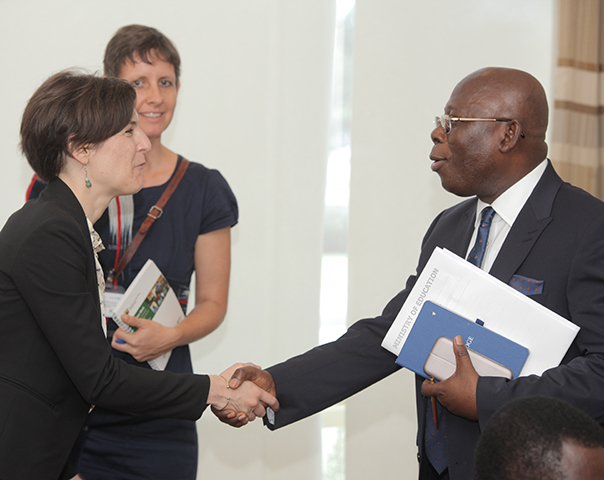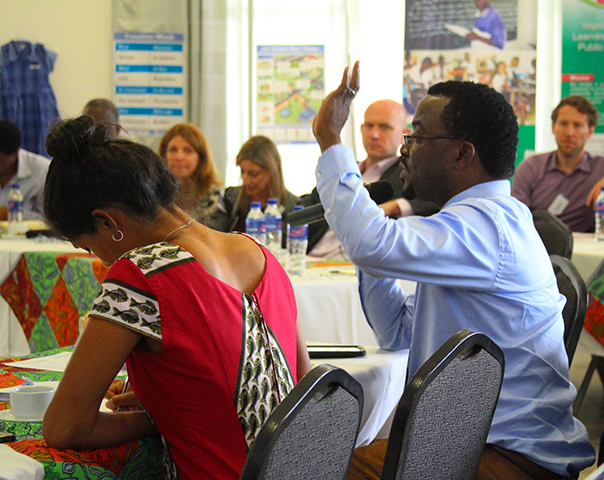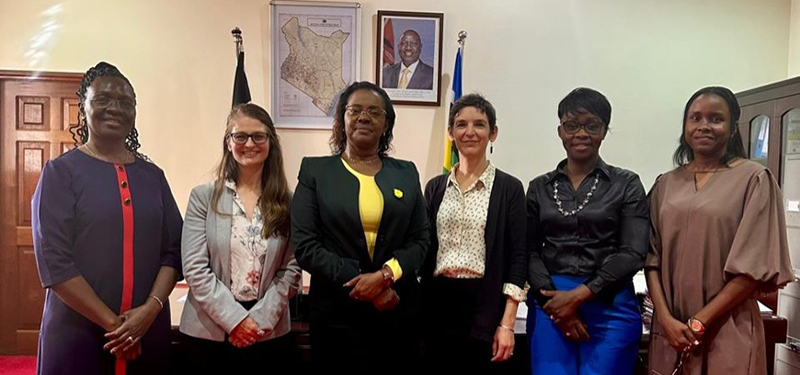
Annie (fourth from the left) pictured with IPA Kenya staff and government officials during a visit to Kenya in 2025
Dear Friends,
As we begin 2026, our core commitment remains unwavering: to create a world with more evidence and less poverty.
The past year marked the culmination of our 2025 Strategic Ambition and reminded us of something essential about IPA: our resilience and our deep commitment to co-creation. As the development sector evolves, more than two decades of experience have reinforced our conviction that generating rigorous evidence is fundamental. But to improve lives at scale, evidence must be paired with strategic, long-term partnerships and systems change. This co-creation approach guides all of our work—from working hand in hand with partners throughout the research cycle to the advisory work of our Right-Fit Evidence Unit, our policy work including the Embedded Labs, and our collaborative efforts to scale evidence-based approaches.
Soon after I started working at IPA, 15 years ago, we partnered with Ghana’s Ministry of Education to locally adapt, test and scale Differentiated Learning—an evidence-based approach to improve foundational reading and math skills. This research and learning partnership of over a decade led to the scale-up of this approach, which has now reached 10,000 schools and 2.4 million learners. It also led to the creation of an Embedded Lab within the Ministry of Education that is working with the Ghana Education Service to support the use of evidence and data in policy decision-making, ensuring evidence is accessible, relevant, and used to improve learning outcomes.
This example illustrates how partnerships with governments in low- and middle-income countries (LMICs) have been central to our Strategic Ambition, built on years of long-term presence and collaboration across the over 16 countries where we work. At a time when bilateral aid has reduced significantly and LMIC governments are the primary drivers of development, working with them to strengthen systems and build evidence ecosystems has never been more critical.
Looking ahead, we are doubling down on our work with and in service of LMIC governments: building on years of experience and learning, we will deepen existing collaborations and expand our reach and capabilities to strengthen our services and impact.
These partnerships with governments, while not the only ones, will play a key role in advancing IPA’s three impact pathways: 1) scaling evidence-based approaches; 2) creating lasting systems change; and 3) building an evidence pipeline. Across these pathways, we will focus on cost-effectiveness and continue to drive innovation.
- Scaling evidence-based approaches: Working with partners around the world, we support the scale-up of established approaches such as Differentiated Learning or the Graduation Approach. We are also advancing our Best Bets—14 interventions with the largest potential for impact at scale. For example, in Sierra Leone, we are working with the Ministry of Health and researcher Anne Karing to boost childhood immunization using a simple, low-cost innovation—a colored bracelet to signal timely and complete first-year vaccinations. Based on promising evidence, the intervention is scaling to 245 government clinics, with ongoing research on cost-effectiveness at scale. In this era of reduced foreign aid and resource constraints, we’re focusing even more on scaling low-cost interventions and on making evidence-based programs more cost-effective. We are also strengthening our scale-up support, working alongside governments and implementers to adapt proven programs for new contexts and build capacity to deliver at scale.
- Creating lasting systems change: While the scale-up of evidence-based approaches can unlock large impacts, institutionalizing the use of evidence will create lasting change that persists beyond individual interventions. In fact, for success, scaling and strengthening systems should go hand in hand. That’s at the heart of our 21 Embedded Labs across 10 countries working within government systems to address priority policy challenges while building internal capacity for the use of data and evidence. Our Right-Fit Evidence unit advises funders and implementers on how to embed truly learning-oriented Monitoring, Evaluation, and Learning (MEL) to achieve greater impact, and develops MEL innovations that can be put to use across our work, including our government partnerships. Going forward, we will deepen these engagements, partner with new types of government agencies, strengthen our services to governments by building new capabilities, and produce more public MEL goods that benefit the entire community.
- Building an evidence pipeline: From discovering new ideas to testing and iterating promising interventions at scale, we aim to generate data and evidence that informs meaningful change. For example, our Climate and Environment Program, launched in 2024, addresses urgent questions at the intersection of poverty alleviation and climate adaptation, such as an evidence review on Payments for Ecosystem Services (PES) and practical implications for conservation programs. In Nigeria, IPA collaborated with the Central Bank to codesign the Digital Financial Services (DFS) User Survey, which provided critical insights into Nigeria's DFS market dynamics and associated consumer risks. To ensure the questions we ask are policy-relevant, and answered through a co-created and rigorous process, we leverage our deep in-country presence and relationships, our global sector knowledge as well as our research network, of which researchers and institutions from LMICs are now working on more than half of our portfolio, as a result of a proactive expansion effort.
To bolster our impact and that of others, we are integrating data science and engineering into our research agendas, and into our core capacities and services. We are innovating research methods to answer a wider range of questions better, faster, and cheaper, and putting existing data into wider use. We are working with our partners to strengthen data infrastructure and usage. For example, IPA partnered with Mentu, a Colombian EdTech organization, to enable rapid learning and improvements on their AI-powered assistant with A/B testing. We are also co-designing solutions with governments to leverage AI for increased impact, for example to predict students’ dropout rates in the Philippines, and working with partners to evaluate AI-enabled approaches, such as Rising Academy’s AI-powered virtual math tutor.
What has made us resilient also positions us well for the years ahead: a dedicated and diverse global staff of over 1,000 people, a long-term presence in over 16 countries, a commitment to co-creation, rigor, and innovation, and unique partnerships with researchers, governments, funders and other key decision-makers. I am filled with both gratitude for how far we have come and confidence in our ability to co-create impact.
Thank you for your continued partnership in this vital work!
With warm regards,
Annie Duflo