
The Challenge
Despite significant progress in recent decades, extreme poverty remains a persistent challenge, affecting nearly ten percent of the global population.1 Most of these households are located in rural farming communities and face multiple interconnected barriers that prevent them from improving their livelihoods, including limited income-generating opportunities, poor health, and low aspirations. IPA evidence has shown that graduation programs—which address these constraints simultaneously through asset transfers, training, and coaching—have been successful in reducing extreme poverty and improving women's empowerment. However, most graduation programs target only the lowest-income households and still largely use expensive individualized training approaches that limit their scalability.
Emerging research suggests that supporting entire villages can create positive economic and social ripple effects2 and can be cost-effective through group-based training if the barriers households face are shared across the community. As such, this can potentially generate larger poverty reductions than just supporting select households. Testing the village-level graduation approach in Uganda—which is among 14 countries accounting for 80 percent of people living in extreme poverty globally3—can provide critical evidence for similar contexts across rural Sub-Saharan Africa.
The Program
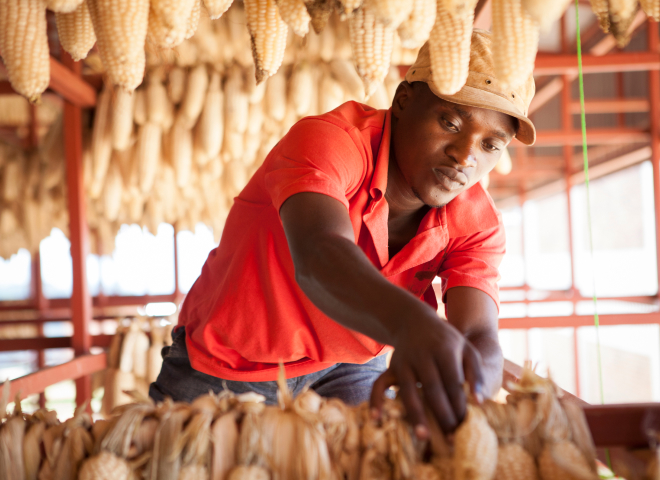
The organization Raising the Village operates a community-level graduation-style program across Uganda. The program provides agriculture and livestock inputs to all households. The program lasts for 24 months and provides intensive group-based training to support all households into income-generating activities and on a path out of poverty. The training primarily focuses on agricultural technology adoption and training; livestock management; livelihood aspirations, financial independence and formation of savings groups; and sanitation training alongside health visits from professionals.
The Evaluation
Researchers are conducting a randomized evaluation in Uganda to measure the impact of Raising the Village’s community-level graduation program. The project involves 3,852 households in 335 villages in Kagadi and Kyenjojo districts of western Uganda. Groups of villages were randomly assigned to either receive the program immediately or serve as a comparison group.
Researchers are collecting data to measure impacts on different indicators relating to household economic outcomes and well-being.
Results
Results will be available in 2026.
Sources
1. United Nations Statistics Division, “Extreme poverty persists, affecting one in ten people worldwide,” United Nations, date accessed December 3, 2025, https://unstats.un.org/sdgs/report/2025/goal-01/
2. Egger, Dennis, Johannes Haushofer, Edward Miguel, Paul Niehaus, and Michael Walker. "General equilibrium effects of cash transfers: experimental evidence from Kenya." Econometrica 90, no. 6 (2022): 2603-2643.
3. Henry Stemmler, Martha Viveros, Federico Haslop, Maria Eugenia Genoni, Christoph Lakner, “Getting to zero: focusing on IDA countries for ending poverty,” World Bank Blogs, November 21, 2024, https://blogs.worldbank.org/en/opendata/getting-to-zero--focusing-on-ida-countries-for-ending-poverty
Implementing Partner