Overview
The Philippines Department of Education (DepEd) is committed to strengthening its education system and improving learning outcomes for all Filipino students. To accelerate progress on this goal, DepEd recognizes the importance of using rigorous evidence to guide decisions about which programs and policies to scale. IPA has partnered with DepEd to establish an Embedded Evidence Lab under its Strategic Management (STRATMA) strand that strengthens the Department's capacity to generate and use data in policymaking. Launched in early 2025, the Lab integrates evaluation and data analytics directly into DepEd's decision-making processes, enabling the Department to systematically test innovations, learn what works in the Philippine context, and scale effective solutions.
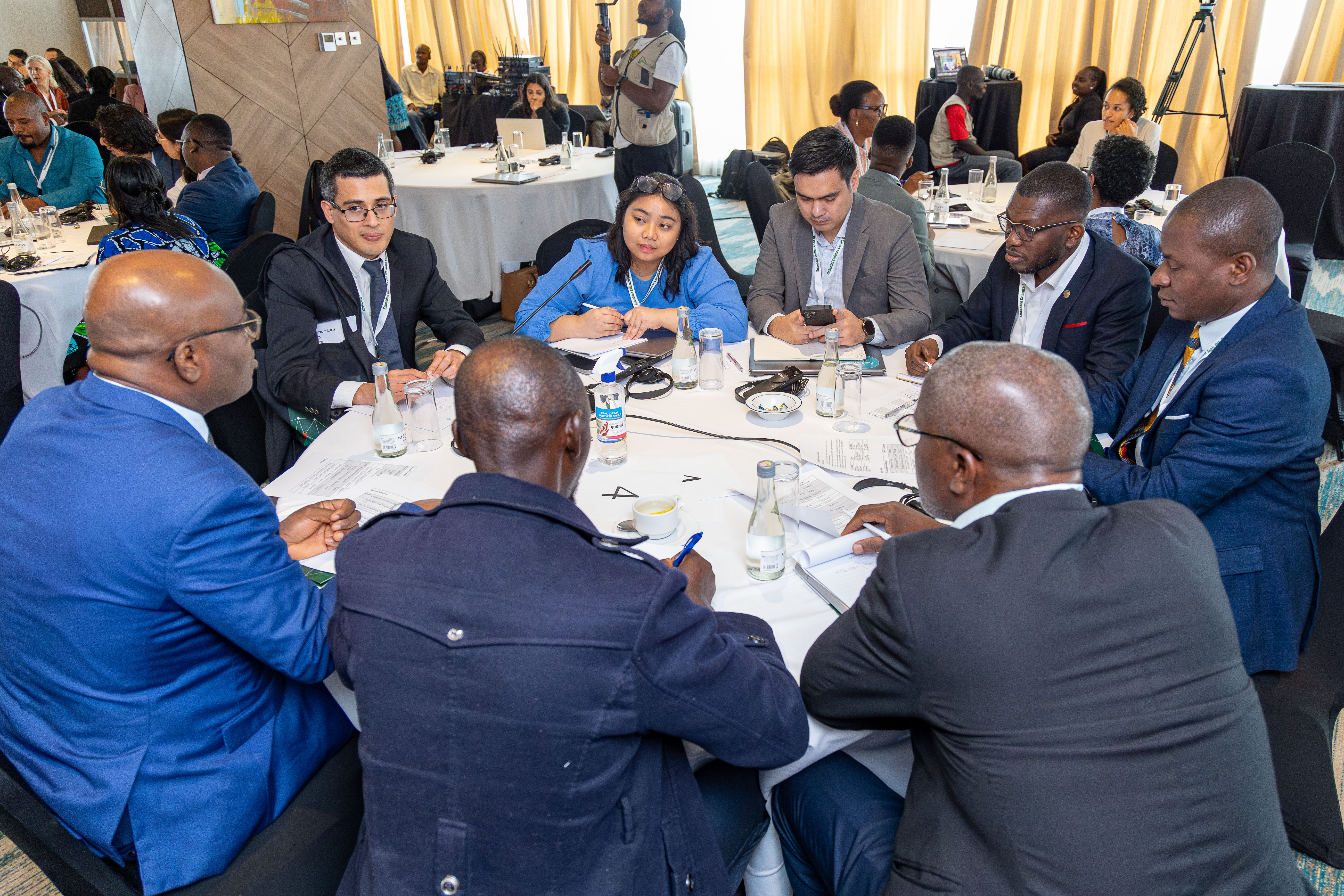
Representatives from IPA Philippines and STRATMA's Monitoring and Evaluation Office (MEO) convened at the Education Sector Cross-Country Learning Exchange event in Nairobi, Kenya in 2025.
Context
The Philippines continues to face persistent challenges in basic education. Even before the pandemic, Filipino students ranked among the lowest globally in reading, math, and science based on international assessments, revealing critical gaps in foundational skills.1 Addressing these requires innovative and evidence-based strategies that support both learners and teachers in improving performance and educational outcomes. The Department of Education has recognized the urgency of these issues and is advancing reforms anchored on the five-point agenda of DepEd’s Quality Basic Education Development Plan: fostering an enabling learning environment, supporting learners’ and teachers’ welfare, prioritizing learners’ well-being, strengthening efficient learning delivery, and nurturing empowered, future-ready Filipinos.
To support this agenda, IPA partnered with DepEd’s Office of the Undersecretary for Strategic Management (STRATMA) to establish an Embedded Evidence Lab. Building on our 10-year partnership with DepEd, the Lab is institutionalizing a structured process to generate, translate, and apply evidence aligned with the Department’s strategic priorities, ensuring that innovations are tested, scaled, and transformed into impactful solutions that raise the quality of education.
Lab Approach
The Lab is hosted under STRATMA’s Monitoring and Evaluation Office (MEO) with government officials from MEO and the Policy and Planning Service (PPS) assigned to it. IPA and DepEd staff co-designed the Lab Learning Cycle, a sustainable process that helps the Department test, adapt, and scale innovations to ensure policies deliver meaningful impact at scale:
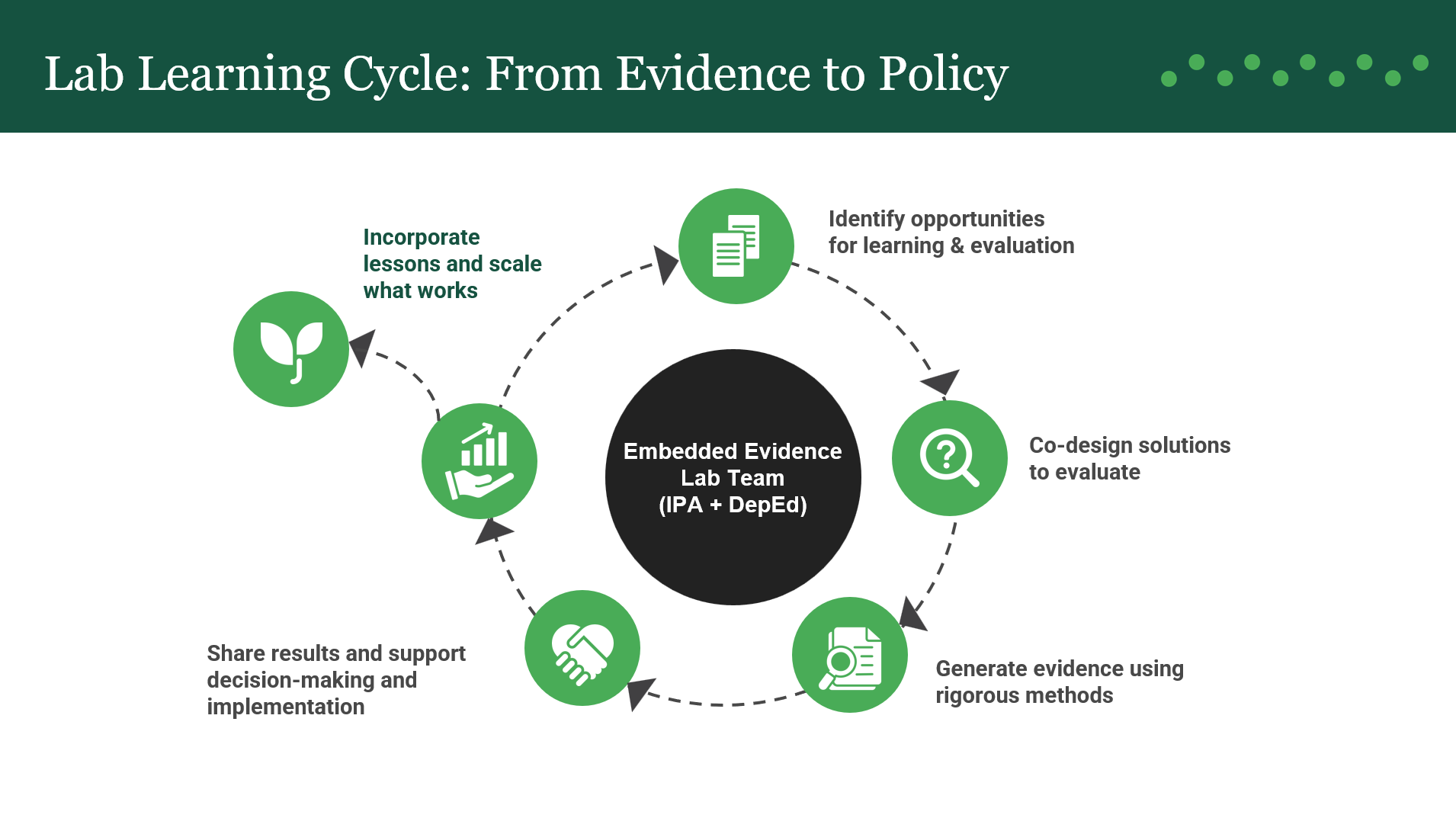
1. Identify opportunities for learning & evaluation: Using DepEd’s Research and Evaluation Agenda, the Lab identifies key challenges and opportunities for learning and evaluation.
2. Co-design solutions to evaluate: The Lab works with DepEd program owners and researchers to design programs or interventions for evaluation, mainly drawing on DepEd’s existing data.
3. Generate evidence using rigorous methods: Together with program owners and researchers, the Lab develops proposals covering intervention design, evaluation design, and implementation. This also includes developing monitoring and evaluation plans, tools, and communication strategies.
4. Share results and support decision-making and implementation: Findings are shared with key decision-makers through briefs, reports, and targeted engagements. Effective interventions are supported for scale-up, while lessons from less effective ones feed back into the cycle to inform continuous improvement.
Lab Achievements
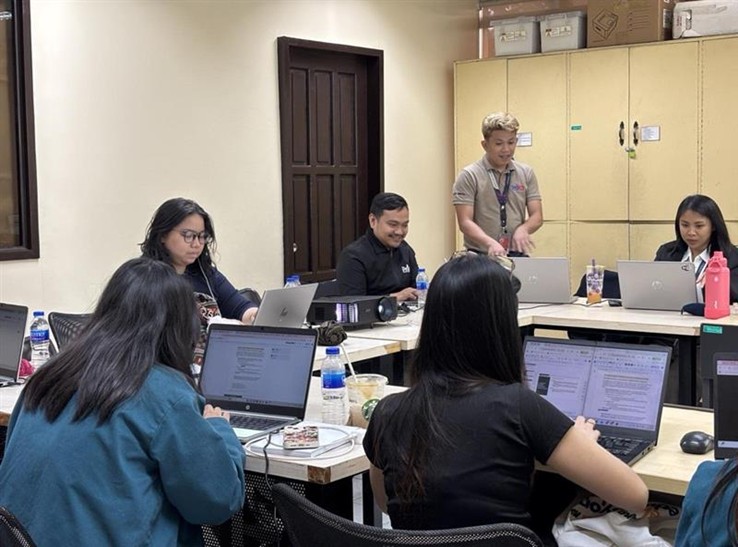
Participants in a workshop with DepEd-PPS worked on drafting the operationalization manual of a machine learning model.
Since its inception in early 2025, the engagement has achieved significant milestones that demonstrate growing ownership within DepEd and tangible progress toward integrating evidence use in decision-making. These include:
1. Progress towards Lab institutionalization: DepEd has taken concrete steps to embed the Lab within its systems:
- The Monitoring and Evaluation Office has been designated as the hosting unit for Lab activities
- Government teams from MEO and PPS have been assigned to the Lab
- These teams are actively engaged in learning-by-doing and are receiving capacity-building trainings to enable them to lead key Lab activities over time
- The Lab's design and roadmap are being co-developed with the Undersecretary and other DepEd leaders to ensure alignment with the agency's priorities
- A Memorandum of Understanding between DepEd and IPA is being finalized to formalize IPA's support in this institutionalization process
2. Launched an evaluation: Together with researchers, the Lab is running an evaluation of an alternative learning program for junior high school students known as the Dynamic Learning Program (DLP), aimed at addressing class overcrowding, frequent suspensions, and multiple class shifts. In preparation for program launch, the Lab has developed the evaluation design, monitoring tools, and a standardized evaluation plan to guide future projects. The Principal Investigators are Noam Angrist (Oxford University) and Aniceto Orbeta (Philippine Institute for Development Studies).
3. Machine-learning driven predictive analytics for dropout prevention: To more carefully examine rising dropout rates, the Lab is developing a predictive model to identify at-risk students. Complementing this, the Lab is preparing a technical report, an implementation guide, and training sessions with key DepEd offices to support integration into DepEd operations and future use.
Learn more here about IPA's work in the Philippines beyond the DepEd Embedded Evidence Lab.
1 PISA 2018, SEA-PLM 2019, and TIMSS 2019