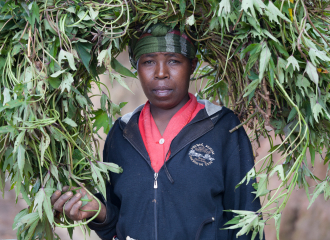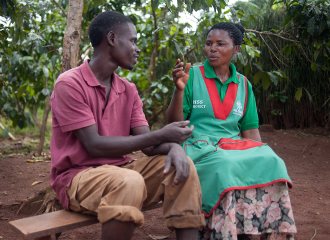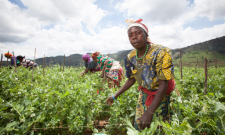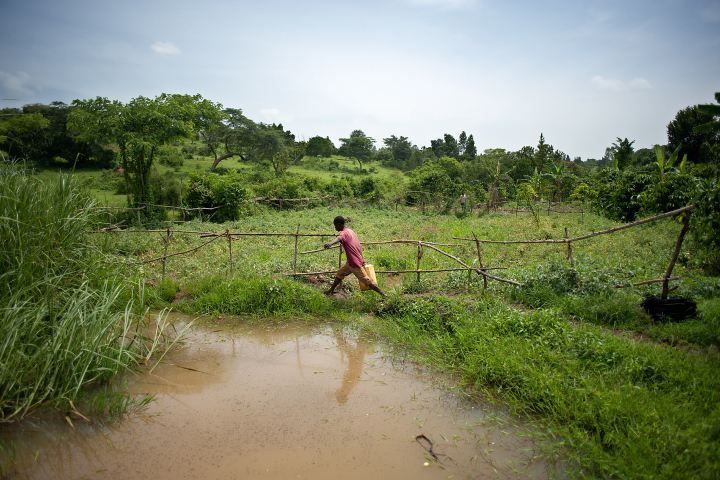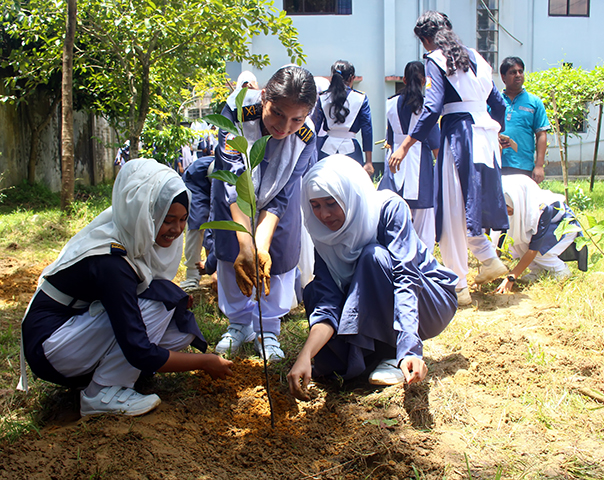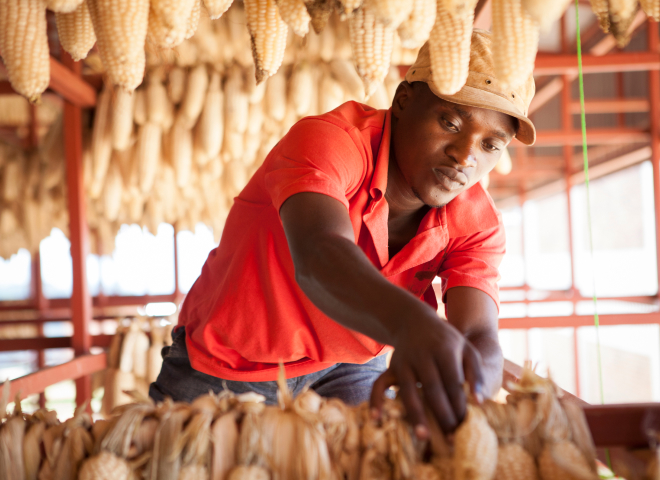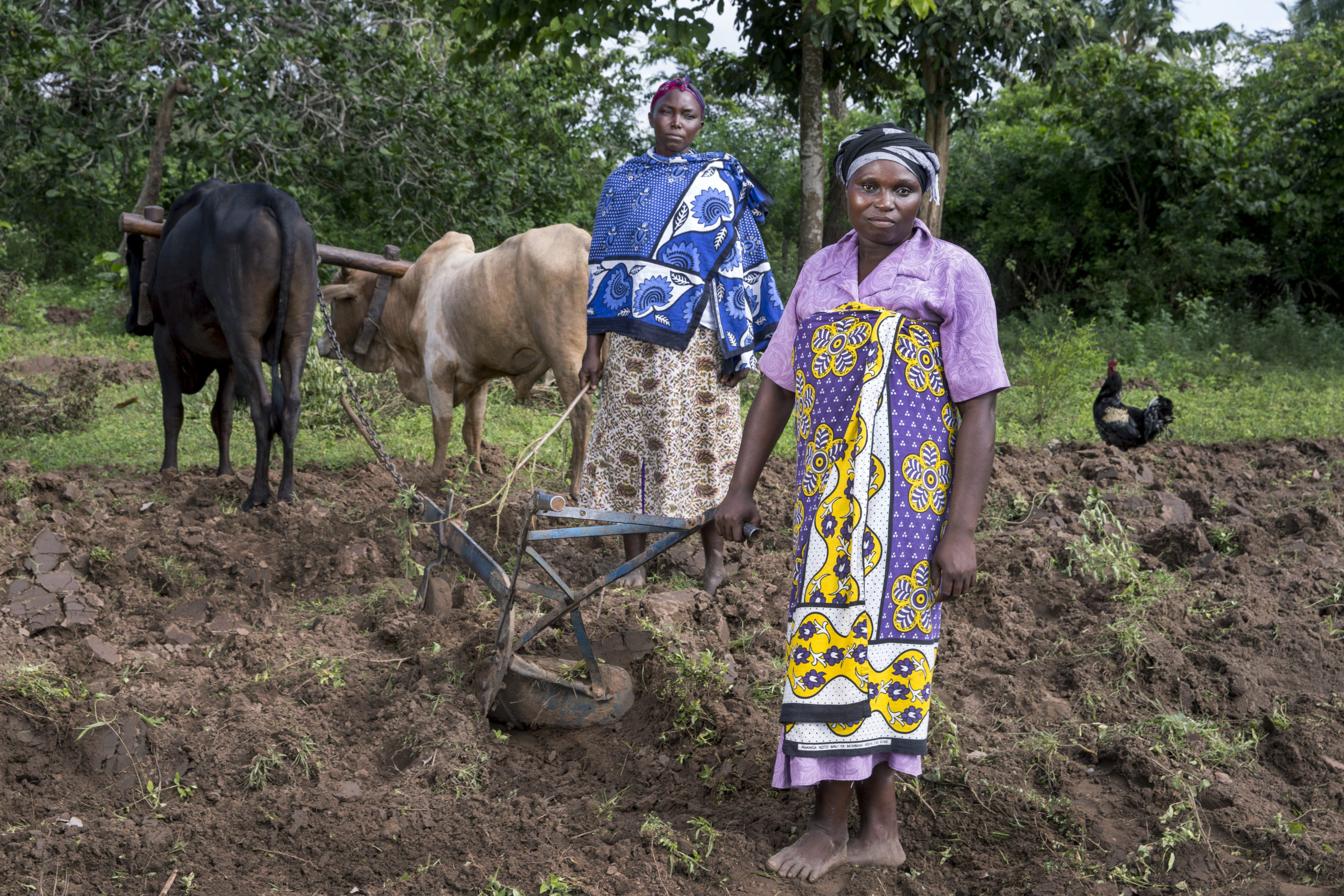
Women who are members of a cooperative group in their fields in rural Kenya. © 2014 Jonathan Torgovnik/Getty Images/Images of Empowerment
Researchers from the International Food Policy Research Institute (IFPRI) and Wageningen University partnered with IPA, Agriculture and Climate Risk Enterprise (ACRE Africa), and the Kenya Agricultural and Livestock Research Organization (KALRO) to evaluate the impact of picture-based insurance and improved drought-tolerant maize seeds to better understand how to strengthen farmers' resilience to climate-related risks. The study found that picture-based insurance nearly tripled in adoption when it was subsidized, and farmers became more confident in it. However, willingness to pay fell significantly when payouts went to a spouse's account or a savings group rather than the farmer directly. Meanwhile, drought-tolerant maize seeds raised yields under farmer-managed conditions, but farmers did not perceive them as more drought tolerant or complementary to insurance and stopped planting them once free distribution ended.
The Challenge
Smallholder farmers face increasing climate uncertainty that makes investing in agriculture both more important and more risky. Droughts, erratic rainfall, and other weather shocks threaten crop production, while rising input costs and volatile markets make it difficult to recover from a poor harvest. As a result, many farmers hesitate to invest in technologies that could improve productivity and resilience, including crop insurance and stress-tolerant crop varieties, agronomic advice, and other productivity-enhancing innovations.
Many of these technologies already exist, yet adoption remains low. Insurance products may not inspire confidence while farmers may not understand how different technologies complement one another. Strengthening farmers' resilience therefore requires more than developing new technologies—it also requires designing, delivering, and scaling them in ways that reflect how farmers make decisions and the constraints they face.
The Program
In Kenya, the Agriculture and Climate Risk Enterprise (ACRE) and the Kenya Agricultural and Livestock Research Organization (KALRO) implemented an intervention to improve agricultural productivity. The program provides different types of seeds: traditional maize, sorghum, and green gram seeds or new improved stress-tolerant varieties of these crops, as well as different types of insurance—weather index-based insurance or picture-based insurance. Index-based insurance uses indices derived from satellite images to assess the damage that farmers may experience. For instance, if rainfall levels fall below a certain threshold, farmers receive an insurance payout. Under picture-based insurance, farmers send pictures of the insured crops as evidence of the damage they experienced.
The Evaluation
To better understand how to strengthen farmers' resilience to climate-related risks, researchers from the International Food Policy Research Institute (IFPRI) and Wageningen University partnered with IPA, Agriculture and Climate Risk Enterprise (ACRE Africa), and the Kenya Agricultural and Livestock Research Organization (KALRO) to evaluate a package of innovations across seven counties in Kenya. For this study specifically, they evaluated the impact of picture-based insurance and improved drought-tolerant maize seeds. The partnership generated evidence on how the design, delivery, and accessibility of agricultural risk-management tools influence farmers' adoption decisions and resilience to climate shocks.
Results
With regard to insurance, the study found that PBI substantially increased insurance uptake. Between 29 and 35 percent of farmers offered free trials of Picture-Based Insurance purchased coverage, compared with 20 to 21 percent of farmers offered free trials of traditional weather index insurance and 13 percent of farmers who were not offered a subsidized insurance product. PBI also improved farmers' confidence in insurance. Farmers were 15.6 percentage points more likely to trust the product, 17.2 percentage points more likely to perceive it as high quality, 14.1 percentage points more likely to understand how it worked, and 12.1 percentage points more likely to expect a payout after crop losses. The largest increases in uptake were observed among women and farmers in Kenya's arid and semi-arid lands, suggesting that reducing basic risk can help expand access to agricultural insurance among underserved populations.
The research also found that who controls future insurance payouts matters. Farmers were willing to pay substantially more for insurance when payouts were deposited into their own mobile money account. Directing payouts to a spouse's account reduced willingness to pay by 29 percent, while directing payouts to a rotating savings and credit association (ROSCA) reduced willingness to pay by 54 percent relative to payouts made directly to the insured farmer. These findings highlight the importance of maintaining control over compensation after a shock and suggest that household financial dynamics should be considered when designing agricultural insurance products.
With regard to improved seeds, the study found that the promoted variety produced higher yields than commonly grown varieties under farmer-managed conditions. However, the variety did not consistently appear more drought tolerant in the field because visible differences largely disappeared under severe moisture stress and as crops reached maturity. As a result, farmers who received trial packs did not perceive the variety to be more drought tolerant than other varieties and were more likely to plant it only while receiving free seed. These findings suggest that simply providing access to new technologies is not enough to drive sustained adoption. The above finding also helps explain results from the insurance research. While farmers valued bundles that combined insurance with stress-tolerant crop varieties, they often did not perceive drought-tolerant varieties to be complementary to insurance. Instead, the benefits of each technology were not always apparent, making it difficult for farmers to appreciate how they address different dimensions of climate risk.
Together, these findings suggest that successful climate adaptation programs should combine access to complementary technologies with communication and extension strategies that help farmers understand when, how, and why different tools work together to strengthen resilience.
Sources
1. Kramer, B., Wellenstein, H., Waweru, C., & Kivuva, B. (2025). Looks Matter? Field Performance and Farmers' Perceptions of Drought-Tolerant Maize in Kenya. Agricultural Systems, 229, 104434.
2. Malacarne, J. G., Kramer, B., & Waweru, C. (2023). Summing the Parts: How Does Bundling Affect Willingness to Pay for Seeds and Insurance in a Sample of Kenyan Farmers?
3. Kramer, B., Malacarne, J. G., & Waweru, C. (2023). Control over Future Payouts and Willingness to Pay for Insurance: Experimental Evidence from Kenyan Farmers.