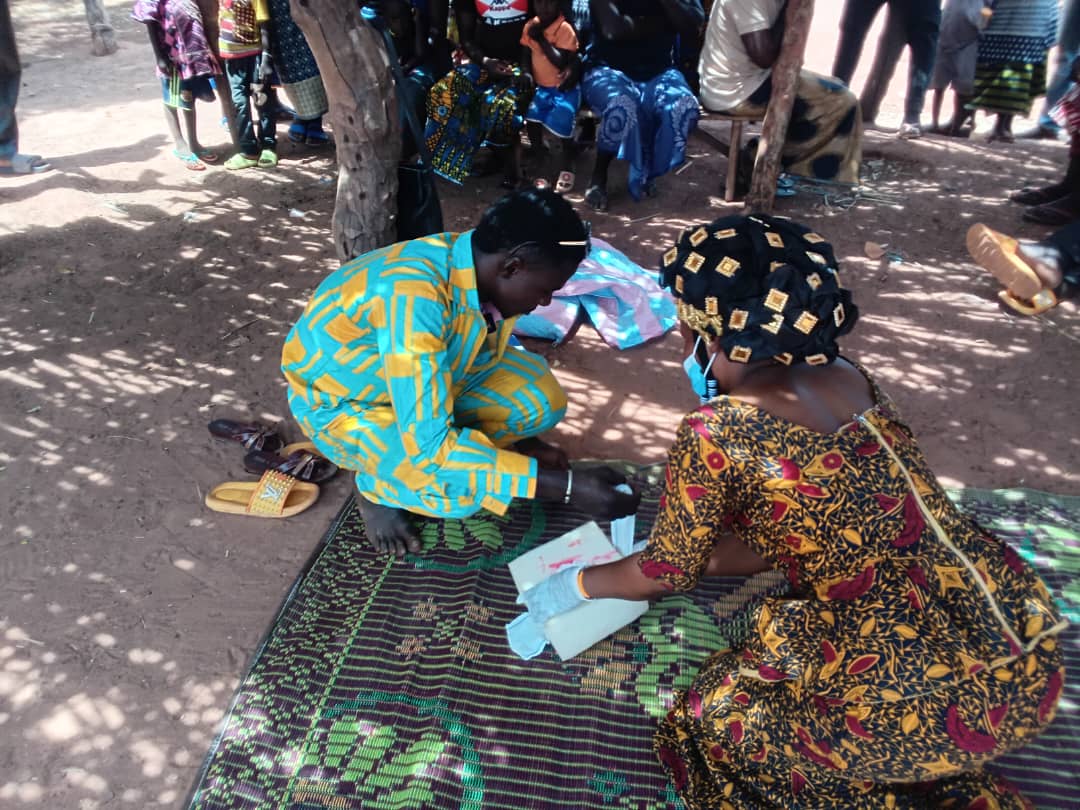
In the minutes after an explosion, formal medical care is rarely close. In conflict-affected communities, the nearest trained health worker can be hours away. The people most likely to help a survivor are bystanders — neighbors, market traders, family members, who typically have no first aid training at all. That gap between injury and care is where most preventable deaths happen.
A pilot study in Burkina Faso, led by researchers Professor Nicolas Meda and Hannah Wild with support from IPA and J-PAL's Humanitarian Protection Initiative (HPI), is testing a direct response to this problem: integrating community first aid training into the mine risk education programs that humanitarian organizations already deliver in the conflict-affected settings.
The idea is simple. Organizations like Mines Advisory Group (MAG), which works within the Global Protection Cluster, already have deep networks in communities affected by landmines and improvised explosive devices (IEDs). Those networks exist to prevent casualties. What if they could also equip communities to respond when prevention fails?
"Preliminary data demonstrate statistically significant increases in both knowledge and skills among community trainees-and more than 33 incident reports documenting real-world use of first aid by trained community members."
Early Results
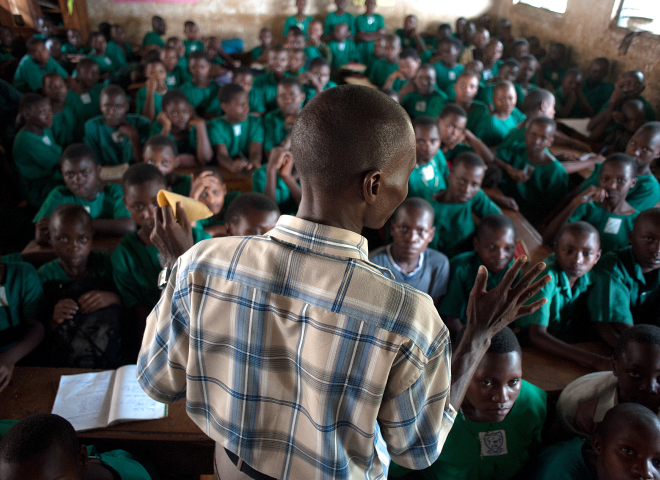
The data from Burkina Faso suggest they can. Sixty-seven local trainers have been prepared across three regional hubs — Ouagadougou, Bobo-Dioulasso, and Dedougou — reaching community focal points from areas affected by insecurity. Those trainers have delivered 56 community sessions to 1,309 participants, 614 men and 695 women, across the Bankui and Tannounyan regions, in collaboration with MAG and its national partners.
Preliminary results show statistically significant gains in both knowledge and practical skills among participants. More than 33 incident reports have already been collected documenting trained community members who used their CFAR skills to provide first aid to an injured person in a real situation.
The urgency is real. Analysis of trauma data from Captain Halassane Coulibaly Military Hospital found that 62.8 percent of casualties between 2020 and 2024 arrived between 12 and 24 hours after injury (Sanou et al.). For people with survivable injuries — isolated extremity hemorrhage, for example — those delays can be fatal. Improving point-of-injury care, even modestly, can change outcomes.
Like many modern conflict settings, Burkina Faso is affected by IED contamination. Over the past decade, the Sahel region has been significantly impacted by terrorism, leading to protracted insecurity and a significant burden of conflict-related injury. This humanitarian crisis has also led to significant displacement, food insecurity, and decreased access to healthcare. Due to factors including remote regions and lack of organized prehospital transport when incidents do occur, delays to reaching care are common and can often be fatal.
"What makes the project notable is not only what is happening on the ground. It is also the speed at which findings have already reshaped global policy frameworks — even before the full evaluation is complete."
In 2024, this project directly contributed to addition of Action 30 to the Siem Reap Angkor Action Plan of the Antipersonnel Mine Ban Convention — the first standalone action on emergency care for explosive ordnance survivors in the convention's framework. That same year, the UN Secretary-General's annual report on improvised explosive devices (A/79/211) included, for the first time, victim assistance and post-injury emergency care as an explicit priority. The language was directly shaped by this research.
In 2025, the work was presented at the Group of Experts meeting on Amended Protocol II to the Convention on Certain Conventional Weapons (CCW) in Geneva and featured at a side event at the 28th International Meeting of Mine Action National Directors and United Nations Advisers (NDM28) Conference.
This policy traction is deliberate. By building the research through genuine partnerships with CORUS (the Ministry of Health's emergency health response unit), MAG, and the National Arms Control Commission (CNCA), the team has established the kind of institutional standing that moves treaty bodies and UN processes. The goal is not a pilot dependent on external funding, but a nationally-owned capability. A stakeholder workshop to plan the handover to CORUS and CNCA took place on March 9, 2025.
Real obstacles remain. Global funding cuts have delayed planned mass casualty simulation exercises. Fewer than 50 percent of trained focal points currently identify as female, despite women facing disproportionate exposure to explosive hazards through activities like firewood gathering and market travel. Closing that gap is a priority. Similar approaches are already being adapted by Pediatric Blast Injury Partnership, The HALO Trust, and Humanity & Inclusion in Syria, Thailand, and Tigray, Ethiopia — a sign that the model is already travelling beyond its pilot setting.
Burkina Faso is not the only setting where HPI is testing this logic. In Myanmar, now ranked among the most heavily landmine-contaminated countries in the world following the intensification of civil conflict since the 2021 coup, HPI is supporting a randomized evaluation to assess the impact of a landmine awareness education program coordinated by CSP (Community Safety Partnerships), which works with several mine action organizations operating in the region, including MAG. The project goes beyond measuring the direct safety effects of mine risk education. It also tests whether reducing landmine-related fear and injury can improve livelihoods: enabling communities to farm land they had abandoned, move more freely, and access schools and markets. The study will evaluate knowledge, behavior, accidents, and economic and psychological outcomes, with findings expected to be generalizable to other conflict-affected settings where mine clearance is not immediately feasible, but education can still save lives and restore mobility.
What comes next
The core argument this research is testing — that mine action and emergency care can be delivered together, through networks that already exist — has already changed the global debate. The full evaluation will tell us how much it changes outcomes on the ground.
For policymakers and practitioners: Organizations working in mine-affected settings and interested in piloting or adapting the EORE-CFAR model can reach out to the HPI team at humanitarian@poverty-action.org