Advancing Evidence-Based Policymaking in Uganda’s Education Sector
Overview
The Education Policy Evidence and Implementation Lab (Ed Lab) is a government-led initiative that places data and evidence at the heart of education decision-making in Uganda. Launched in 2023, the Ed Lab is housed in the Ministry of Education and Sports’ Education Policy and Research Department, and receives technical support from IPA and funding from the LEGO Foundation. The Ed Lab empowers policymakers to generate, interpret, and apply evidence to tackle Uganda’s most pressing education challenges.
Context
Uganda has made significant strides in expanding access to education, but major challenges remain in quality, equity, and learning outcomes. In 2023, fewer than 20% of O-level students passed physics and chemistry, and 83% of late primary learners could not read fluently.1 The report shows that fragmented data, limited research capacity, weak evidence-to-policy processes, and underuse of administrative data could inform better decisions.
The Ministry of Education and Sports’ Education Policy and Research Department (EPAR) holds the mandate to address these gaps through policy review and development research and evaluation, technical guidance, quality assurance, and promotion of equitable access. The Ed Lab strengthens this mandate by embedding a cycle of evidence generation, translation, and institutionalization directly into MoES operations. By turning education challenges into well-defined policy questions and tested solutions—while enhancing the Ministry’s capacity to use and act on evidence—the Ed Lab reinforces EPAR’s role in advancing equitable, high-quality, and outcomes-focused education.
Through the Ed Lab:
- Evidence is co-generated with policymakers and tailored to their needs.
- Insights are translated into actionable plans and tools that fit within government systems.
- Decision-making becomes timely and data-driven at critical moments of policy design, budget allocation, and program implementation.
- Institutional structures and capacities are strengthened to sustain use of evidence over time.
Our Approach: A Four-Stage Learning Cycle
The Ed Lab uses an iterative learning cycle closely aligned with government planning processes, to embed evidence use into decision-making.
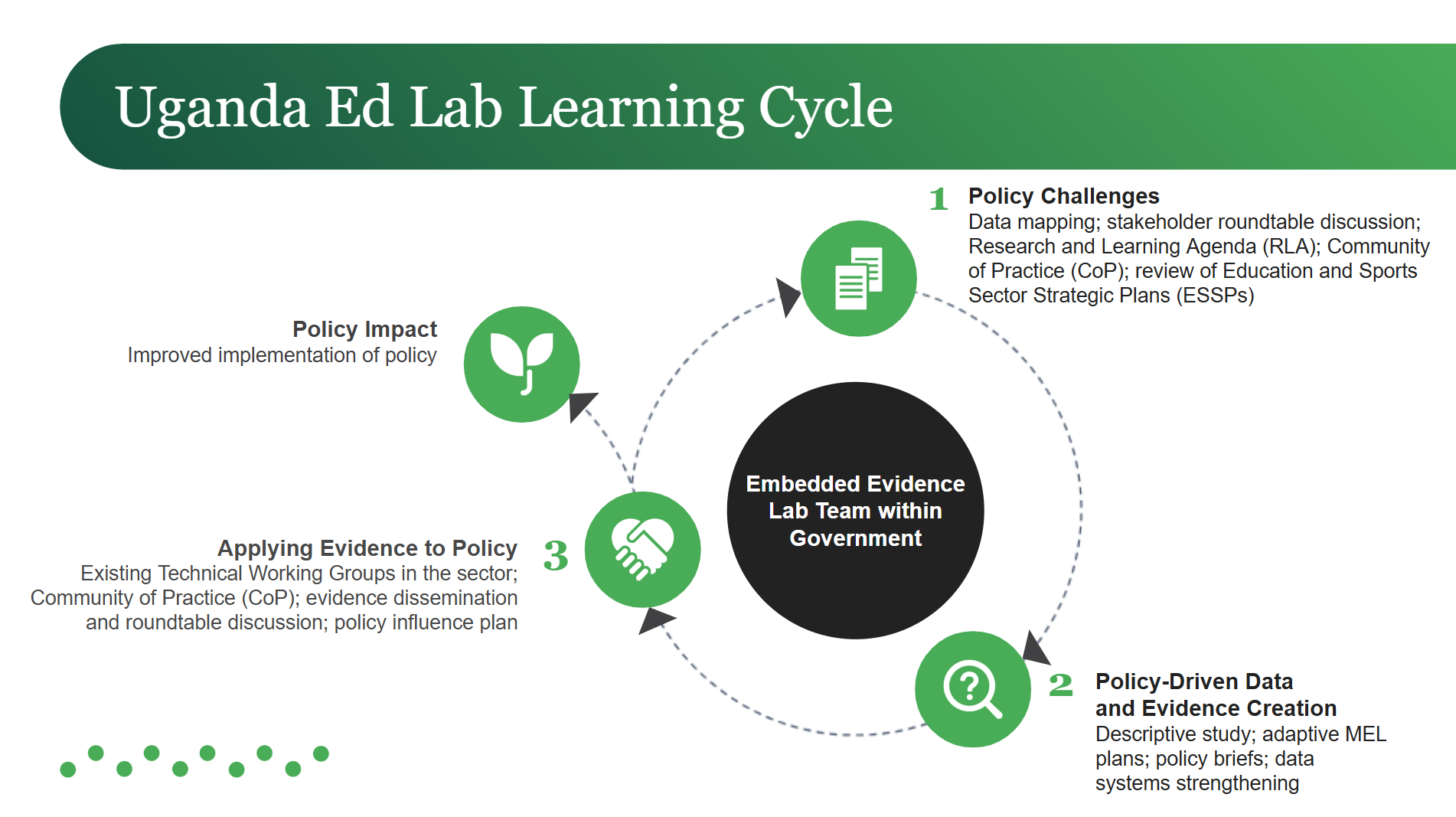
1. Policy Challenge Mapping: We work with MoES teams to identify priority education issues and translate them into research questions aligned with the sector's strategic goals, co-developing a Research and Learning Agenda.
2. Data & Evidence Generation: The Ed Lab designs and conducts rigorous research including descriptive studies, predictive analysis, and impact evaluations, as well as monitoring, evaluation, and learning (MEL) systems. This may also include partnering with academic institutions and the use of administrative data to produce timely insights.
3. Applying Evidence to Policy: Results are translated into accessible and actionable products such as policy briefs, innovation memos, presentations to senior decision-makers, and tailored feedback to implementing departments.
4. Policy Impact: We support MoES to embed evidence-informed practices into planning cycles, policy documents, and data systems while building institutional capacity through technical assistance and staff mentorship.
Our Work in Action
From identifying pressing policy questions to informing real-time decisions, the Uganda Ed Lab has been instrumental in translating evidence into impact. Here are key highlights of our work:
Building System-Wide Capacity for Evidence Use
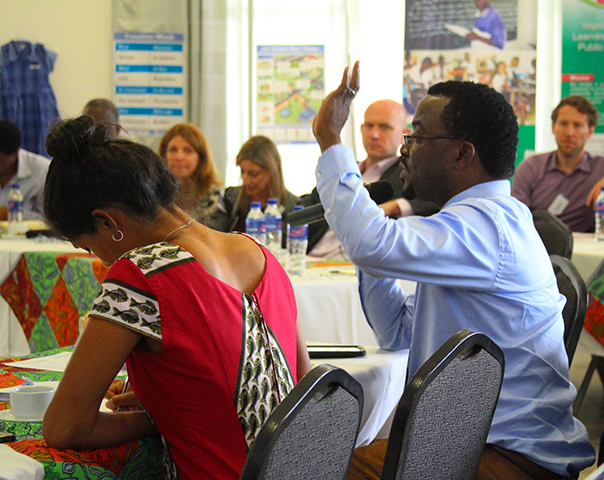
The Ed Lab operates through a secretariat that coordinates data and evidence use across ministry departments and agencies. Members of the secretariat, nominated by their departments and appointed by the Permanent Secretary, play a pivotal role in framing policy questions, mapping available data and evidence, and fostering uptake through a monthly Brown Bag evidence-sharing series.
This mechanism has generated significant system-wide benefits:
- Increasing demand for evidence across all MoES departments to support their work
- Structured co-design processes that produce studies that are more relevant and actionable, directly addressing the questions policymakers need answered
- Stronger government ownership that enhances the likelihood that reforms will be scaled and sustainable beyond pilot phases
- Peer learning with other countries accelerates innovation and impact, as ministries share strategies and lessons learned
From Research to Reform: Addressing Poor Performance in Science Subjects
A flagship study on the causes of poor performance in science subjects at lower secondary level served as the Ed Lab’s proof of concept, completing a full learning cycle from research to implementation. The challenge was urgent: in 2023, pass rates in physics and chemistry at O-level hovered below 20%, threatening Uganda's ability to develop the STEM workforce needed for economic transformation.
Working closely with EPAR and the Government Secondary Education Department, the Ed Lab provided technical assistance to design a study, which analyzed administrative data on teacher qualifications, student enrollment patterns, and examination results across government secondary schools. The results informed teacher recruitment targeting to address staffing gaps in science subjects and guided the drafting of the National Science Policy issues paper. In addition, the Ed Lab is supporting the Gender Unit in mapping Violence Against Children (VAC) indicators, thereby advancing the implementation of the Ministry’s Elimination of Gender-Based Violence and VAC Strategy in the education sector.
Other studies conducted by the Ed Lab:
- Strengthening Teacher Retention through Administrative Data: High turnover among teachers—particularly in rural areas—disrupts student learning and strains school budgets. Yet the Ministry lacked clear data on which teachers leave, when they leave, and why. The Ed Lab is working with MoES to analyze payroll and human resources data to identify attrition patterns and predictors. This study serves a dual purpose: producing evidence to inform retention policies while simultaneously building ministry staff capacity to conduct similar analyses independently in the future. Early insights are already shaping discussions about teacher incentives, career progression pathways, and deployment policies.
- Improving Learning Outcomes: Responding to 2024 Primary Leaving Exam Results: Following concern over the 2024 Primary Leaving Examination results, the Ed Lab is working with MoES in refining research questions and study design to identify solutions for improving learning outcomes. The 2024 results showed that too many students were completing primary school without foundational literacy and numeracy skills, prompting urgent calls for intervention that can be rigorously studied, ensuring the intervention will be evidence-based rather than reactive.
- Enhancing Teacher Effectiveness through Digital Data Systems: In collaboration with the Directorate of Education Standards (DES), the Ed Lab is enhancing the use of Teacher Effectiveness and Learner Achievement (TELA) and E-Inspection data to strengthen teacher effectiveness and learner achievement.
- Supporting Policy Implementation: Early Childhood Care and Education: The Ed Lab is also supporting the rollout of the Early Childhood Care and Education policy, and co-leading the research and MEL agenda for the national School Feeding Policy to ensure accountability and impact. Together, these efforts demonstrate how the Lab turns data into actionable evidence, builds institutional capacity, and drives reforms that advance equitable, high-quality education.
Looking Ahead
From inception, the Uganda Ed Lab has been co-designed with MoES to ensure sustainability. IPA Uganda provides embedded technical assistance initially, but progressively transfers full ownership to the Ministry. Alongside strengthening government systems, the Lab supports internal capacity building, budget integration, and the embedding of evidence into strategic planning, ensuring it becomes a permanent pillar of education governance.
With foundations now in place, the Ed Lab is focused on scaling evidence‑informed programs, institutionalizing evaluation routines, and enhancing the use of administrative data for real-time insights. The Lab is building collaborations with researchers, funders, and global education partners to co-create a future where every learner benefits from evidence-informed policy.
1 https://observer.ug/education/uce-2023-overall-pass-levels-up-as-poor-science-results-continue-to-cause-concern-2/