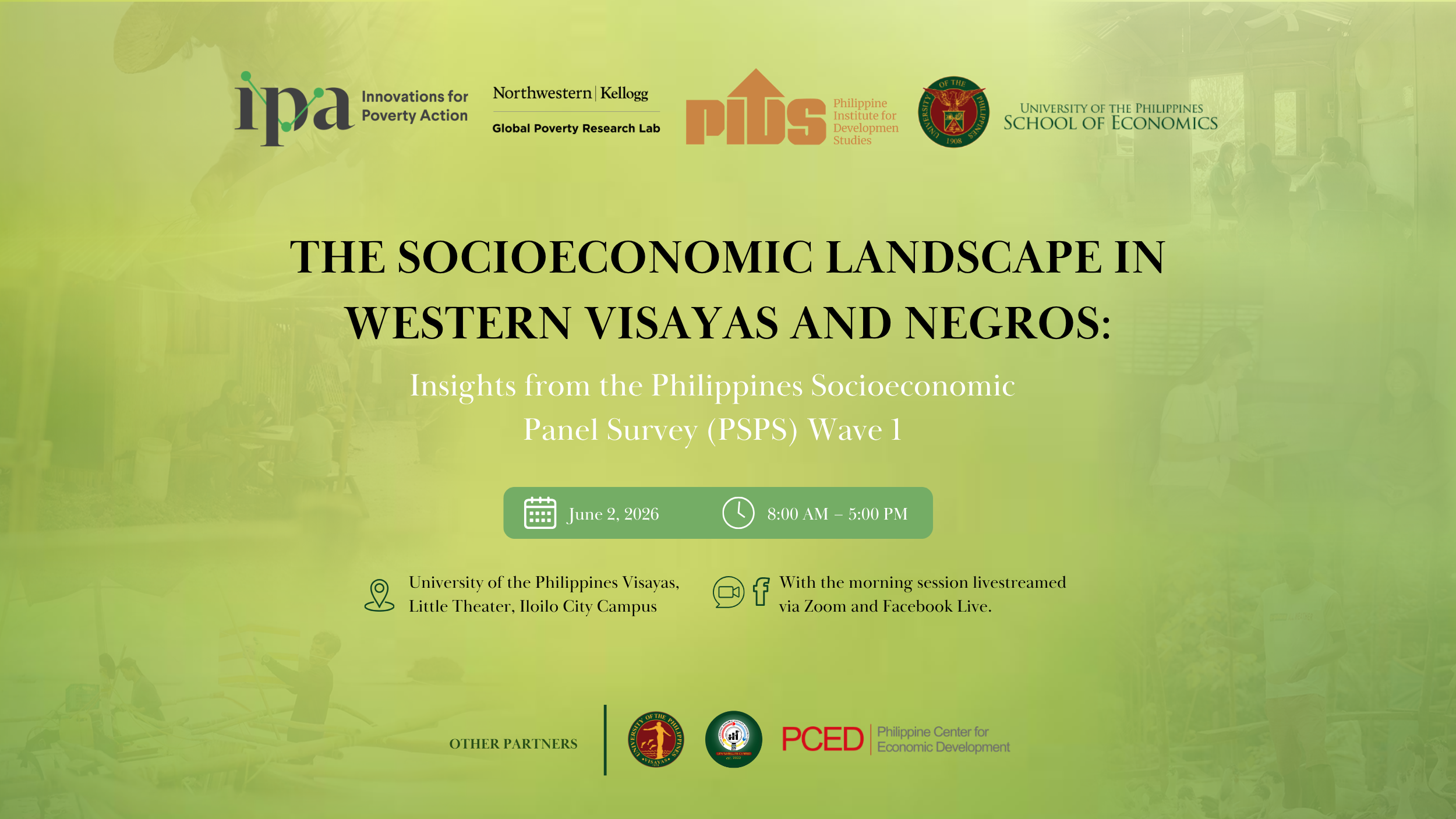
The Socioeconomic Landscape in Western Visayas and Negros: Insights from the Philippines Socioeconomic Panel Survey (PSPS) Wave 1
2 June 2026 8:00 AM - 5:00 PM, Philippines | via Zoom
Note: Online participation will only be available during the morning sessions.
A major constraint in understanding development is the absence of long-term, high-quality data. Most data collection efforts are carried out at a single point in time and focus on only a few variables of interest, which limits the potential for evidence-based policy and long-run planning. Panel studies can offer rich, comparable data by regularly tracking individuals over an extended period across many dimensions.
Innovations for Poverty Action (IPA) Philippines and the Global Poverty Research Lab (GPRL) at Northwestern University (NU), in partnership with the Philippines Institute for Development Studies (PIDS) and the University of the Philippines School of Economics (UPSE), have launched a twenty-year panel survey, the Philippines Socioeconomic Panel Survey, tracking more than 15,000 rural households across five provinces in Western Visayas (Aklan, Antique, Capiz, Iloilo) and the Negros Island Region (Negros Occidental). Learn more about the PSPS.
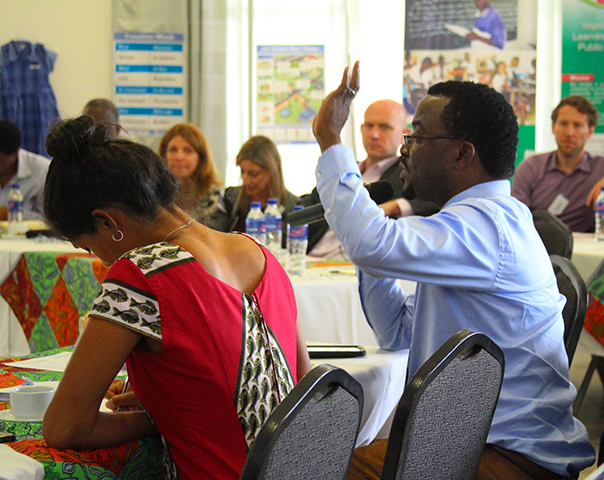
On June 2, 2026, stakeholders from government, academia, and the development sector gathered at the University of the Philippines Visayas (UPV) Iloilo City Campus and online for the National Launch of the PSPS Wave 1 Data. The event marked the completion of Wave 1 data collection and the beginning of a long-term effort to generate evidence on the socioeconomic conditions and trajectories of Filipino households.
The program featured a keynote address from Dean Karlan, Northwestern University Professor of Economics and Finance and Founder of IPA, alongside a presentation of descriptive statistics from PSPS Wave 1. A panel discussion with policymakers and practitioners explored key policy priorities, implementation challenges in designing and evaluating programs, and opportunities for collaboration using panel survey data. Afternoon breakout sessions focused on impact evaluation, research design, and the use of PSPS data for policymaking.
Watch the event recording below:
Double your impact by supporting IPA today
For a limited time, a generous anonymous donor will match online donations up to $50K. Donate today to double your impact while helping provide steady, sustainable support to IPA.