Strengthening data and evidence-based decision-making in the gender and social development sector
Overview
The MGLSD Embedded Evidence Lab is a joint initiative of the Uganda Ministry of Gender, Labour and Social Development (MGLSD) and Innovations for Poverty Action (IPA), established in July 2025. It provides a range of services to support evidence use; strengthen monitoring, evaluation, and learning (MEL) systems; co-create research and learning agendas; and translate evidence to inform decision-making, program development, and policy design. The Lab’s early achievements include conducting evidence reviews, facilitating stakeholder consultations, and co-chairing technical working committees to inform the development of an evidence-based National Gender-Based Violence (GBV) Action Plan 2026-2031. The lab also reviewed the MGLSD Strategic Plan (2025-2030) to ensure the inclusion of evidence-related commitments to inform the generation and utilization of data for decision-making.
Context
The Ministry of Gender, Labour and Social Development is the largest central government agency providing national-level policy direction on gender and women's empowerment, social protection, labour and employment, early childhood development, and the empowerment of marginalized groups, including the elderly, youth, tribal minorities, and persons with disabilities.
The Ministry collects and hosts large amounts of administrative data and maintains several management information systems. The effective use of this data requires translating it into usable formats for decision-makers and building a strong culture of evidence generation and use through strengthening internal systems and technical capabilities. To achieve this, the Ministry with IPA’s support established an Embedded Evidence Lab. The Lab was initiated in July 2025, building on a formal collaboration that began in 2023 and a Memorandum of Understanding signed in October 2024.
Our Approach
IPA and MGLSD staff co-designed the Lab's learning cycle, an iterative process to generate, synthesize, and apply data and evidence for decision-making.
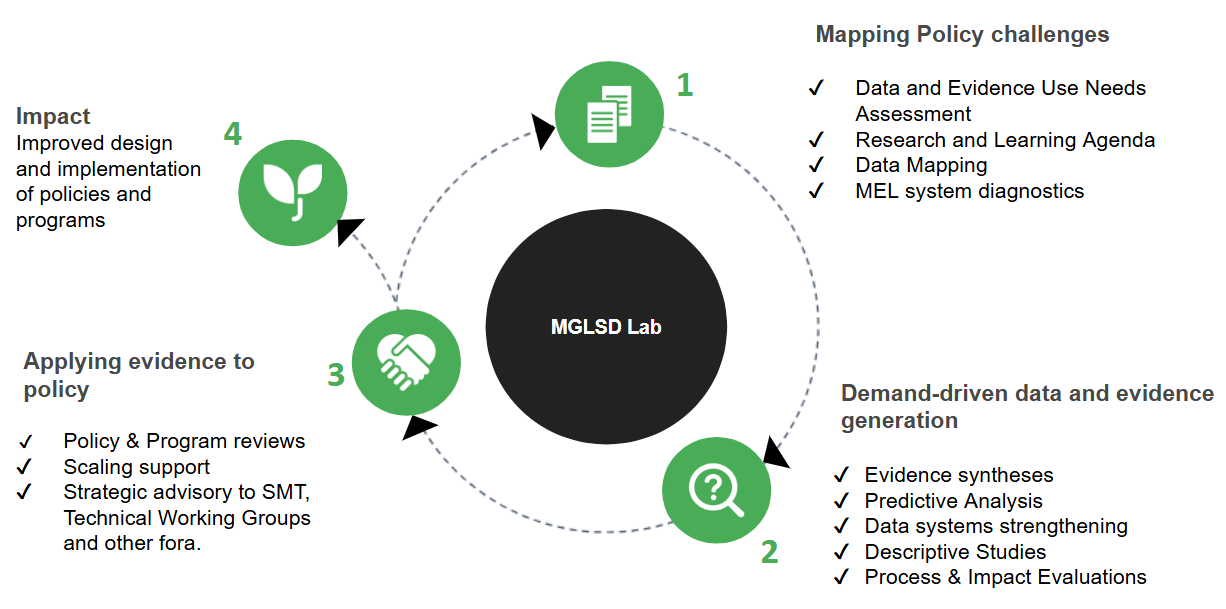
- Mapping policy challenges: The Lab uses an iterative co-creation process to identify priority data and evidence needs aligned with MGLSD’s strategic priorities.
- Demand-driven data and evidence generation: The Lab collaborates with researchers and other partners to design and conduct evidence syntheses, administrative data reviews, MEL plans, and rigorous studies to inform policy and program decisions.
- Applying evidence to policy: Data and evidence are translated into products such as policy briefs, analytics sheets, and presentations to inform policy design, program reviews, and scaling. These products are tailored for different audiences, including MGLSD’s Senior Management, Sectoral Working Groups, and other partners.
- Embedding evidence in policy and practice: The Lab supports MGLSD to embed evidence-informed policy and program design to improve service delivery.
Lab Achievements
Since its launch in July 2025, the Lab has reached several milestones that demonstrate growing MGLSD ownership and progress toward embedding evidence in decision-making. These include:
- Leading a participatory data and evidence use needs assessment and co-creating a Ministry-owned research and learning agenda, which identified priority evidence gaps and capacity needs and anchors the Lab’s evidence generation strategy.
- Reviewing and strengthening MGLSD’s five-year Strategic Plan (2025/26–2029/30) to embed evidence generation and use as core institutional priorities, with formal commitments to robust M&E frameworks, strengthened administrative data systems, implementation of the research agenda, and staff capacity development aligned with the Lab’s workplan.
- Co-developing an MEL framework that strengthens the Ministry’s capacity to routinely collect, analyze, and use high-quality data for adaptive policy and programmatic decision-making. This is essential to ensure the Strategic Plan drives tangible results, not just formal adoption, by reinforcing accountability, enabling timely course correction, aligning resources with strategic priorities, and institutionalizing a culture of continuous evidence use across the Ministry.
- Developing an action-oriented MEL plan for the National Policy on the Elimination of Gender-Based Violence (GBV), to enable MGLSD to systematically monitor the rollout of the 2026-2031 GBV Action Plan and use implementation data to inform adaptive programmatic decisions for women and girls.
- Constituting and leading capacity building for an internal team to lead concept development, stakeholder engagement, and fundraising for scaling edutainment, one of IPA’s Best Bets, through MGLSD projects. The initial idea is to scale edutainment to address negative social norms that perpetuate violence against women and girls.
- Formalizing the Lab by appointing cross-departmental senior representatives and securing endorsement from the Permanent Secretary, establishing clear terms of reference and institutional backing from the outset.
- Enhancing MGLSD’s internal capacities using a learning-by-doing approach and tailored trainings that equip the Ministry staff with skills to facilitate the generation and use of evidence.
Looking Ahead
- Operationalizing the Research & Learning Agenda for sustainable evidence leadership. The Lab will implement the co-created research and learning agenda to generate evidence to inform the Ministry's most pressing policy questions, focusing on gender-based violence (GBV), women’s economic empowerment (WEE), early childhood development (ECD), and social protection.
- Strengthening the Lab’s institutional foundations and building a pipeline for sustained evidence generation. The Lab will refine its governance and reporting structures, develop an operational manual, advance a transition plan toward greater government leadership, and establish a pipeline of Proofs of Concept that positions the Lab as a continuous, demand-driven platform for evidence-informed policymaking rather than a one-off project.
- Strengthening partnerships for evidence generation. The Lab has led the initial steps of constituting a Social Development Partners’ Working Group as a platform that brings together MGLSD and its partners to share evidence on what works and share implementation lessons for evidence-based decision-making. This platform will be used for lab socialization and resource mobilization.
Learn more about IPA's work in Uganda.