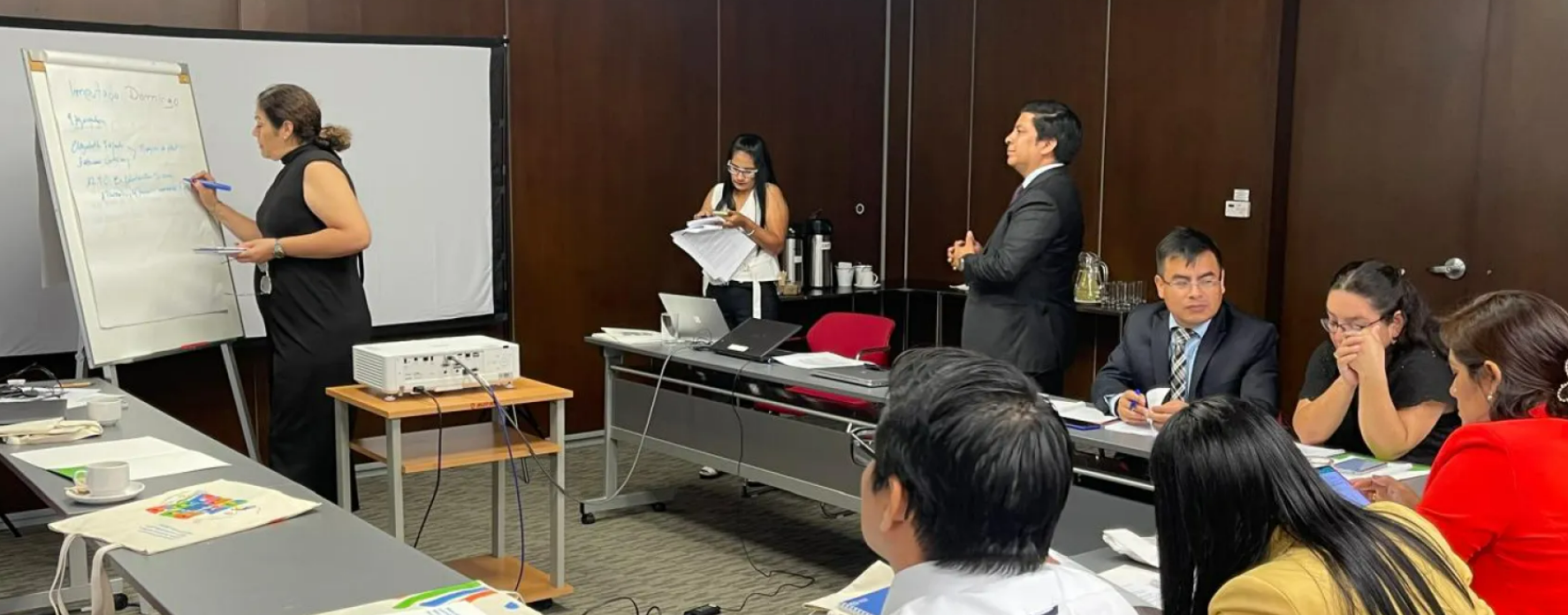
Funded by IPA's Human Trafficking Research Initiative, researchers in Peru are evaluating two complementary anti-trafficking interventions: (1) a prosecutor training program to improve conviction rates, case resolution time, and victim-centered practices, and (2) a municipal police (Serenazgo) training pilot to strengthen community-level identification, documentation, and referral of trafficking victims. Results will be available in 2027.
The Challenge
Despite increased attention and efforts by governments in Latin America to prosecute cases of human trafficking, convictions remain an obstacle. For example, in Peru, only 1.58 percent of a reported 1,900 trafficking cases in 2024 led to convictions.1 Challenges include limited prosecution effectiveness and a complex migration context with 1.5 million displaced Venezuelans that can make it difficult to identify and provide legal protection for victims. Addressing these interconnected challenges requires a broader intervention: strengthening formal prosecution capacity while building community-level identification systems that can recognize trafficking early and refer cases effectively to formal justice mechanisms.
To bolster prosecutors' capacity in trafficking cases, the TRACK4TIP program implemented by the UN Office on Drugs and Crime provides specialized training on trafficking law interpretation, protective-centered prosecution practices, evidence collection protocols, inter-agency coordination, and protective-informed interviewing. This is done through mock trials, case study analysis, and mentorship. Although evidence suggests the promise of justice system training,2 their effectiveness in the context of human trafficking is not yet known. Can this intervention prove effective in improving institutional capacity against human trafficking? How do institutional and community-level interventions interact to strengthen the anti-trafficking system?
The Intervention
Researchers are conducting an evaluation in Peru to measure the impact of the TRACK4TIP program. The intervention involves 12 regions (a total of 147 prosecutors), taking advantage of the training’s staggered rollout between 2022 and 2023. Researchers will collect data from more than 1,200 trafficking prosecution cases from 2010 to 2025 and analyze 4,000 judicial sentences using natural language processing to measure conviction rates, case resolution time, sentence length, trafficking charge severity, victim-centered practices, and inter-agency collaboration.
Second, researchers will implement a Serenazgo municipal police training through a pilot in 10 districts and, if results are positive, implement a randomized evaluation across 20 high-trafficking districts. The randomized evaluation will measure trafficked person identification rates, referral completion and quality, quality of documentation practices, officer knowledge, and community trust. This integrated institutional-community approach will provide unique causal evidence on prosecution-focused interventions in migration and high-crime contexts, directly informing international organizations' scaling decisions and regional anti-trafficking policies.
Results
Results will be available in 2027.
Sources
1. Ministerio Público, 2024
2. Blattman, C., Green, D., Ortega, D., & Tobón, S. (2021). Place-based interventions at scale: The direct and spillover effects of policing and city services on crime. Journal of the European Economic Association, 19(4), 2022-2051.
Double your impact by supporting IPA today
For a limited time, a generous anonymous donor will match online donations up to $50K. Donate today to double your impact while helping provide steady, sustainable support to IPA.