The Rwanda Education Evidence Lab (Ed Lab) is an embedded government team established in 2019 to strengthen the use of data and evidence in education policymaking. It is a joint initiative launched by Innovations for Poverty Action (IPA) and the Georgetown University Initiative on Innovation, Development and Evaluation (gui2de), embedded within the Ministry of Education (MINEDUC) and its implementing agencies—the Rwanda Basic Education Board (REB) and the National Examination and School Inspection Authority (NESA)—to improve education outcomes through evidence-informed policy and implementation.
The Lab follows the Embedded Evidence Lab model developed by IPA, embedding technical staff inside government institutions to connect policy priorities with data analysis, research, and implementation support.
Team, institutional positioning, and functions
The Lab consists of six full-time staff members placed within the three institutions to support policymaking and implementation. Ed Lab staff work in:
- Education Sector Planning, Monitoring and Evaluation (ESPM&E) department of the Ministry, which oversees education data and tracks progress on both government programs and development partner priorities
- Directorate of Digitalization of the Ministry of Education, which coordinates Information and communications technology or ICT policy, planning, and implementation to modernize the education sector. It drives digital literacy, improves educational technology infrastructure, develops digital learning content, and facilitates online services for teachers and students.
- Teacher Development and Management (TDM) department of the Rwanda Basic Education Board (REB), responsible for overseeing more than 110,000 teachers nationwide through the Teacher Management Information System (TMIS)
- Examinations and Learning Achievement Unit (ELAU) of the National Examination and School Inspection Authority (NESA), which regulates national assessments and exams to safeguard quality in basic education
In addition to the embedded staff, the Lab includes a team that provides support to scale up proven evidence-based interventions. This distributed structure (as per the diagram below) allows the Ed Lab to work directly with policy teams, data systems, and program implementers.
Lab approach: A three-step learning cycle
The Ed Lab follows the three-step Learning Cycle that helps translate policy challenges into evidence-driven solutions:

- Identifying and prioritizing policy needs and translating them into clear research and learning questions
- Generating relevant evidence and data products using a range of approaches, including evidence synthesis, impact evaluations and A/B testing, descriptive and predictive analytics, and Monitoring Evaluation and Learning (MEL) routines
- Connecting findings to decision-makers and supporting their adoption, operationalization, and implementation
Across these functions, the Lab promotes evidence-informed policymaking by embedding technical staff within government institutions, strengthening national data systems and translating research into actionable policy and implementation.
Initiatives and impact
The Ed Lab has implemented the following key workstreams, with signs of programmatic and system-level impact as described below:
1. Supporting the scaling of Supporting Teacher Achievement in Rwandan Schools (STARS) (Payment for Performance Contract Teacher Scheme): Building on a rigorous evaluation conducted between 2015 and 2018, the Ed Lab is supporting the STARS team to test variations of performance contracts and identify the most effective approaches to improving teaching and learning. In parallel, the Ed Lab is supporting the nationwide scale-up, which is expected to reach 3,548 schools and 107,411 teachers. The lab is strengthening data systems, supporting the training of inspectors, headteachers and teachers, and facilitating policy engagement to embed contract management within existing government systems. Learn more about the impact of STARS.
A Multipronged Strategy for Effective Evidence Use
The Rwanda Education Lab illustrates how an Embedded Lab can combine research, relational, and systemic strategies to support a reform from evidence generation to national scale-up. The Lab connected findings from the STARS evaluation with government decision-makers and used A/B testing to identify an implementation model that was feasible and cost-effective at scale. Throughout this process, the Ed Lab and STARS team also mobilized political engagement around the evidence and secured high-level buy-in for the scale-up model, including through direct engagement with the Minister. The Lab coordinated MINEDUC, NESA, REB, and district authorities through a monthly task force that clarified responsibilities, strengthened political and institutional support, and prepared inspectors and headteachers to implement the new performance contracts. At the systems level, the Lab strengthened national education data systems, including CAMIS and TMIS, and established monitoring processes to track implementation, identify challenges, and support course correction across the country.
|
- Strengthening information systems: The Ed Lab is strengthening two core national education information systems that support evidence-informed decision-making across Rwanda's education sector:
- Comprehensive Assessment Management Information System (CAMIS): The Ed Lab has supported the national rollout and continuous improvement of CAMIS, which now covers 89 percent of primary and secondary schools and contains over 158 million assessment records. As CAMIS has become central to STARS teacher performance management, the Ed Lab has strengthened the system through improved data validation, user access controls, and system monitoring. As a result, the share of student marks recorded in CAMIS increased from 40 percent to 90 percent during the 2024–25 school year. The data are now routinely used by policymakers to monitor learning outcomes and identify more than 200,000 students needing remedial support ahead of national examinations.
- Teacher Management Information System (TMIS): The Ed Lab has upgraded TMIS into a comprehensive teacher management system supporting more than 100,000 basic education teachers and 5,000 TVET teachers. New modules—including teacher vacancies, transfers, maternity leave management, and teacher scholarships—have strengthened workforce planning while embedding equity considerations into teacher management. Integration with the government payroll system has improved teacher deployment and salary verification, and real-time dashboards now enable policymakers to monitor workforce trends and make faster, evidence-informed staffing decisions.
- Originally strengthened to support the national scale-up of STARS, CAMIS and TMIS now provide the digital infrastructure for a growing range of education policies and reforms, demonstrating how investments in government data systems can generate benefits well beyond a single program.
2. Strengthening data and evidence use for government decisions: In addition to supporting these systems, the Ed Lab conducts ongoing analytical work using administrative data to address emerging policy questions. This work strengthens the Ministry’s capacity to routinely use data for policy design, monitoring, and system management and improvement:
- Semi-annual analyses of Rwanda’s teaching workforce using TMIS data to identify trends and emerging teacher-management challenges
- Teacher recruitment and placement analysis. Early work included analysis of teacher placement and the 2020 hiring cycle as the government shifted responsibility for teacher recruitment and deployment from districts to MINEDUC and REB. Findings were used to inform the development of a national teacher recruitment framework and tools to operationalize the recruitment process. Subsequent retrospective analyses have continued to support improvements in teacher placement systems.
- Term-level analyses of student performance using CAMIS, enabling targeted support for underperforming schools and students
- Development and testing of AI-enabled tools that leverage TMIS and CAMIS data to improve teacher placement, including a teacher-facing chatbot and a data-driven matching algorithm
Together, these activities illustrate a progression from producing individual analyses toward establishing routines through which government administrative data can continuously inform policy design, implementation, monitoring, and system management.
Ai4Gov: Improving teacher placement through AI: The Lab helps the ministry use AI to improve educational outcomes
The Rwanda Education Lab is supporting REB and MINEDUC to strengthen teacher placement through two AI-enabled tools: a chatbot embedded in TMIS and a data-driven matching algorithm. The chatbot will help teachers understand placement rules and assess their likelihood of assignment specific districts, while the algorithm will use TMIS and CAMIS data to improve teacher matching by predicting teacher retention and value added and compare alternative matching approaches with current assignment practices. Both tools will be integrated into TMIS and managed by Ministry staff to support long-term government ownership. IPA and gui2de will support prototype development within REB’s infrastructure and continue to strengthen capacity within the ministry. Following prototype development, the solutions will undergo model testing and a randomized evaluation before making any decisions to scale.
|
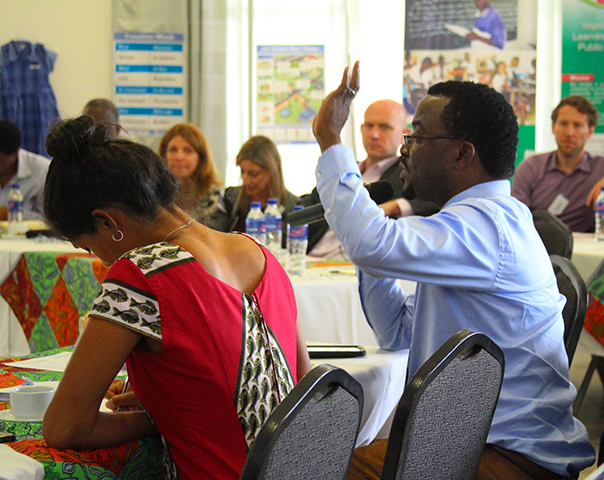
3. Events and workshops: Alongside technical work, the Rwanda Ed Lab convenes forums and workshops to share evidence, strengthen collaboration, and build capacity:
- Teacher Dialogue: A forum to share evidence on teacher management reforms and gather feedback from teachers
- STARS Workshops: Dissemination of results and engagement with district leaders and national agencies to support potential nationwide scale-up of teacher performance contracts
- CAMIS Engagements: Technical meetings and workshops to coordinate partners, strengthen data analysis, and improve reporting of student learning data
- Cross-Country Learning Exchange: Participation in IPA’s annual exchange for Education Labs, where government and Lab teams learn from peers, share lessons and tools, and explore solutions to common implementation and institutionalization challenges
Forward-looking priorities
Moving forward, the Rwanda Ed Lab will support the national scaling of STARS, continued strengthening of information systems, and institutionalization of evidence use:
- Supporting the national scale-up of STARS: A key priority for 2026-27 is to continue providing support for the nationwide scale-up of the STARS program, which started in the school year 2025-26. The scale-up will reach approximately 3,548 schools and 107,411 teachers. This will include, strengthening data verification systems, assisting in ongoing monitoring and evaluation of program activities, and continuing policy engagement to improve contract management systems within government processes.
- Continued strengthening of education data systems: The Ed Lab will continue expanding the functionality and reliability of CAMIS and TMIS, including deeper integration with other government systems and improved analytics dashboards.
- Leveraging AI to improve education outcomes: Building on the data infrastructure developed through STARS, the Lab will support REB and MINEDUC in exploring applications of AI. This includes developing and testing AI-enabled solutions, while strengthening government capacity to manage, evaluate, and eventually institutionalize these tools.
- Expanded evidence generation: The Lab will maintain its analytical work on teacher workforce trends and student performance while supporting government teams to strengthen internal capacity for data analysis and evidence use.
- Institutionalizing evidence use: A longer-term priority is embedding evidence-driven decision-making across the Ministry and its agencies so that data routinely informs education policy and program implementation.