MANILA CITY, September 21, 2026 – Lower fees can significantly increase how often Filipinos use digital payments, according to a new study by Innovations for Poverty Action (IPA), led by Professor Russell Toth of the University of Sydney, in partnership with Rizal Commercial Banking Corporation (RCBC), in consultation with the Bangko Sentral ng Pilipinas (BSP). The study found that when the fees for transfers between different account-holding institutions were reduced, mass-market (lower-income) customers nearly doubled their use of InstaPay, while usage among mass-affluent (higher-income) customers increased by about 30 percent.
The findings come from an independent impact evaluation involving approximately 15,000 mass-market and mass-affluent customers using RCBC’s mobile banking platforms who consented to participate to receive four different variations of reduced fees for InstaPay transfers, including zero pesos, over the course of four to five months.
InstaPay enables customers to make real-time transfers between accounts held at different account-holding institutions. These are known as off-net transfers, as opposed to transfers between accounts within the same account-holding institution.
“The study is the first impact evaluation study conducted globally to measure price sensitivity: how consumers use InstaPay when faced with different price levels,” said Professor Toth.
The study also found that lower fees did more than increase the number of transfers. They also changed how people transacted. When fees were lower, customers tended to make smaller, more frequent transfers rather than waiting to make fewer, larger payments. Lower fees also encouraged some customers who had not used InstaPay recently to begin transacting again, although the increase in usage was lower among customers who were already active users. The effects were broadly similar across demographic groups, including age and gender.
Beyond how people respond to different fees, the study also looked at how much benefit Filipinos get from using InstaPay. The findings show that lower transaction fees provide substantial benefits to consumers, while higher fees reduce those benefits. Access to InstaPay is estimated to generate at least PHP 45 billion per year in aggregate consumer welfare across the Philippines–this is how much worse off Filipino consumers would be if InstaPay were removed as a payment instrument.
The results align with the BSP’s Circular No. 1238, which introduced a pricing policy framework for digital payment services anchored on fair, transparent, and reasonable pricing.
"The study provided useful evidence on how pricing influences user behavior and engagement, particularly among more price-sensitive customers. The findings help move the discussion from assumptions to evidence and can inform how we design policies and products that support sustained participation in the digital financial ecosystem," said BSP Deputy Governor Mamerto E. Tangonan, Head of the Payments and Currency Management Sector.
Assistant Governor Dennis Bancod of the Payments and Currency Development Sub-sector adds, “The next policy levers we may look at [are] not really to go beyond pricing, but looking at the relationships, activities, and value-added services attached to pricing.”
“Digital payments will not win on price alone. They win when they are trusted, secure, reliable, and fast. Make digital payments so seamless that cash becomes the exception, not the default,” said Lito Villanueva, Executive Vice President and Chief Innovation and Inclusion Officer of RCBC. "The study shows that when we reduce friction, people transact more. That makes pricing not just a revenue decision, but also an inclusion decision," added Villanueva.
The research was presented on August 19, 2026, at the "Pricing of Retail Off-Net Payments: Evidence and Insights Forum," at the BSP Head Office, Manila.
Contact: Aftab Opel, Country Director, IPA Philippines (aopel@poverty-action.org)
About Innovations for Poverty Action
Innovations for Poverty Action (IPA) is a global research and policy nonprofit that discovers and advances what works to improve the lives of people living in poverty. IPA works with researchers, policymakers, and practitioners to generate and apply rigorous evidence to improve lives.
About RCBC
RCBC (Rizal Commercial Banking Corporation) is one of the top banks in the Philippines. Currently ranked as the fifth largest privately owned bank in the country, RCBC offers a full range of financial products and services to individuals and businesses nationwide for 65 years and counting.
Recognized as the Best Bank for Digital and Best Bank for Customer Experience, RCBC continues to drive innovation through customer-focused, technology-driven solutions. The bank is a proud member of the Yuchengco Group of Companies (YGC), one of Southeast Asia’s most established conglomerates. To learn more, visit www.rcbc.com.
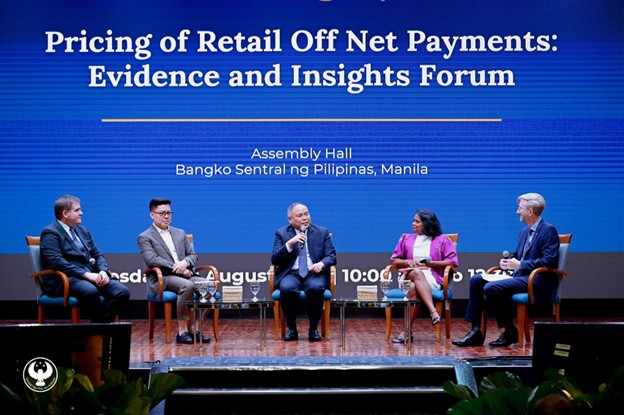
Panel discussion on the pricing of retail off-net payments. (From left) Russell Toth, University of Sydney; Lito Villanueva, RCBC; Assistant Governor Dennise Bancod, BSP; Isvary Sivalingam, Better than Cash Alliance; and Paul Adams, IPA, during the Pricing of Retail Off-Net Payments forum held on August 19, 2026, at the Bangko Sentral ng Pilipinas Head Office.