This is Part 1 of a two-part blog series drawn from qualitative insights gathered in focus group workshops in Uganda and Nigeria, where women shared their experiences with technology-facilitated gender-based violence (TFGBV). Read Part 2: "Five Lessons for Measuring Technology-Facilitated Gender-Based Violence."
Technology is woven into everyday life. Women use it to run businesses, stay connected with family, find jobs, access financial services, and navigate their communities. The very technology that connects us and facilitates our daily life, however, can also be used to amplify and extend gender-based violence. For many women and gender non-conforming people, however, digital spaces are yet another place where they are exposed to old and new harms. An abusive partner uses a woman’s phone to track or threaten her. Online strangers publish someone’s private information and she starts receiving credible threats. Peers pile on humiliating comments after she posts on social media.
Over the past two years, sistemaFutura and IPA have been working to develop a measure of technology-facilitated gender-based violence (TFGBV) to capture the day-to-day reality of women in Uganda and Nigeria. We began by reviewing existing instruments used to measure technology-facilitated abuse. The review, published earlier this year as a compendium, highlighted the rapid growth of the field but also revealed important gaps.
Insights from Compiling the Compendium
The review found that TFGBV is measured in many different ways, with tools designed for high-income settings or highly public individuals. For example, tools developed in a large city in a High-Income Country (HIC) might include items about doorbells that record people approaching a front door. Measures for public leaders might ask about deep fakes of videos pulled from speeches they gave. These are important expressions of TFGBV, but they may be less applicable in East, West, and Southern Africa, where the research team works. They may not match the experience of women who use technology in daily life, but not in a public role.
Length was also a concern. Some measurement tools focus on only a subset of abusive behaviors, which risks missing important experiences and connections. Others list upwards of 30 potential TFGBV experiences, which makes them hard to take up in existing research. Many teams and governments the research team spoke with want a "goldilocks" measure — one with enough specific examples to be relevant while remaining brief enough for routine surveys.
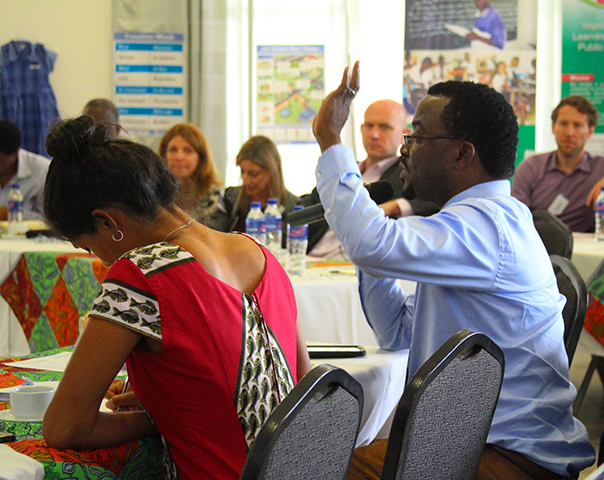
To address this gap, the research team held participatory workshops with women from different socioeconomic backgrounds in urban Uganda and Nigeria. Researchers presented workshop participants with 18 forms of TFGBV identified in the literature from around the globe and asked them to review illustrated cards and discuss the impact of each form of TFGBV in their lives. Across both Uganda and Nigeria, participants rarely struggled to relate to the scenarios presented. Even when women did not have a name for a given form of TFGBV, or had not experienced it themselves, they often knew someone who had. Discussions moved naturally from one example to another, with women drawing on experiences involving friends, sisters, colleagues, customers, neighbors, and members of their communities.
This first blog explores what women shared with researchers about who experiences technology-facilitated violence, who enacts it, and where women turn for support.
Finding 1. Perpetrators are often known, and predominantly male
Perpetrators discussed were mostly men and often known to the survivors. They include current or former partners, coworkers, bosses, neighbors, ex-classmates, and community members. This challenges a common assumption that online harm is primarily anonymous.
Rather than asking about "online violence," researchers used realistic scenarios depicting experiences such as receiving unsolicited sexual content, having intimate images shared without consent, or being doxxed. The findings show that tech-facilitated violence overlaps with other forms of gender-based violence (GBV): online abuse amplifies, extends, and enables violence that is already happening in daily life.
Despite most experiences involving known perpetrators, stranger-led harms also appeared. Trolls and scammers used targeted tactics (e.g., fabricating emergencies, establishing romantic connections, or fake job opportunities) to build trust and carry out large-scale fraud. In Nigeria, women named these unknown perpetrators "Yahoo Boys," a relic of the early 2000s when scammers used yahoo.com email services, chat rooms, and webmail to target women.
Women — including peers, co-wives, or online spectators — also participated in certain forms of harm, such as spreading rumors, sharing intimate images out of envy or conflict, or joining group attacks through comments or gossip. This complexity matters: TFGBV cannot be reduced to a simple binary of male perpetrators and female survivors. Revictimization is common, as survivors are blamed for being vocal online or for having shared intimate content privately.
Finding 2. Socioeconomic status shapes how violence is experienced and recognized
One of the most significant findings is how socioeconomic status shapes both the form TFGBV takes and how it is understood.
With greater income, connectivity, and social media presence, women's exposure changed. The more visible a woman becomes online, the more that visibility can be weaponized against her. Women with greater digital literacy and access were more likely to discuss AI-generated content, identity theft, location tracking, and threats associated with greater online visibility. They were more familiar with different types of harm and the terms used to describe them.
Women with basic phones also talked about TFGBV in their daily lives. For them, digital life is closely tied to their ability to earn a living and provide for the household. Phones and social media are tools for selling products, finding clients, and accessing job opportunities. This creates specific vulnerabilities. Scammers exploit dependence on phones by reaching out with fake offers, and harassers repeatedly call advertised numbers. For some, controlling partners seek to monitor communications or become jealous when women receive calls from unknown callers.
Finding 3. TFGBV shares common patterns, but local contexts shape the intensity, frequency, and harm
Many experiences were consistent across Uganda and Nigeria. Women in both countries discussed online harassment, financial scams, intimate image abuse, digital surveillance by partners, impersonation, and coordinated attacks on reputation.
Body-shaming and societal pressure—around marriage, childbearing, and appearance—were also raised in both countries as forms of online violence, even if many women did not initially identify them as harm.
Yet important differences also emerged.
Women in Uganda frequently described technology as an extension of intimate partner violence and coercive control. Mobile phones became tools for monitoring movements, checking communications, restricting social relationships, and reinforcing existing power dynamics within relationships. Participants also described the role of technology in financial exploitation and scams targeting women seeking economic opportunities.
In Nigeria, conversations placed greater emphasis on reputational harm, public visibility, and hacking. Women discussed coordinated online harassment, impersonation, image manipulation, and the potentially devastating consequences of public shaming, particularly for women running businesses or maintaining professional profiles online. They were also well-versed in different forms of phone cloning, hacking, and tracking.
The differences observed across socioeconomic and country contexts reinforce an important point: technology-facilitated violence is not experienced uniformly. It reflects the social, economic, and cultural contexts in which women live.
Finding 4. Formal systems are not trusted to respond to TFGBV
When discussing where women seek support, participants consistently pointed first to informal networks.
Trusted friends, family members, feminist nongovernmental organizations (NGOs), community leaders, and religious support (such as prayer and church communities) were commonly described as the first sources of advice and emotional support. Many participants expressed hesitation about reporting incidents to police or formal authorities, often citing concerns that their experiences would not be taken seriously or would be difficult to prove. In Nigeria, some women noted awareness of the Cybercrime Act but expressed doubt about whether it would be applied fairly or effectively.
This does not necessarily mean formal systems are unimportant. Rather, it highlights that women navigate technology-facilitated violence within broader social support systems that shape whether and how they seek help. Self-protective measures were also common: blocking perpetrators, changing phone numbers, deleting accounts, and reducing online activity.
Finding 5. What women said they need
Participants in both countries articulated a clear vision of what would help. Some spoke about digital literacy training, particularly for women from lower socioeconomic backgrounds who could benefit from skills to recognize and respond to online harms. Participants also spoke about mental health and psychosocial support that is accessible and non-judgmental.
Several also described a need for economic empowerment, since financial dependence increases vulnerability to grooming, scams, and remaining in harmful relationships. For community-based support systems, some women spoke about the need for trusted spaces where women can speak without shame.
Those with an online presence sometimes mentioned platform accountability, including better content moderation, privacy controls, and reporting mechanisms. While participants themselves did not raise this point, the research team recognizes the need for stronger policy and regulation on online harm and data protection.
The next blog explores what these conversations mean for researchers and practitioners. The workshops challenged several common assumptions about measuring TFGBV and point toward a more contextually grounded approach to research and policy.