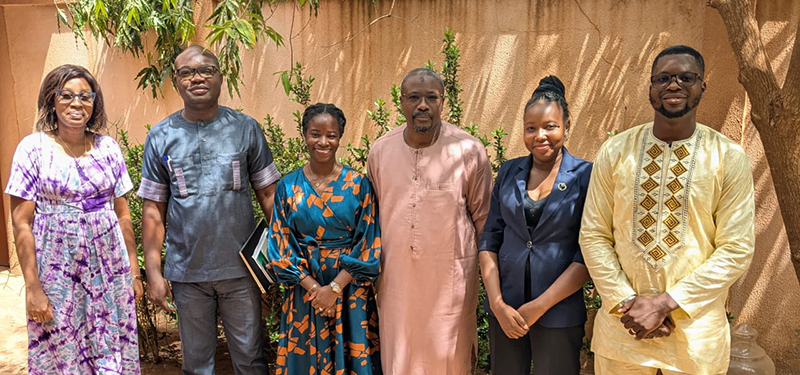
Innovations for Poverty Action (IPA) and Development Media International (DMI) staff photographed at the DMI country office in Ouagadougou, Burkina Faso in May 2025. From left to right: Mireille Belem, Director of Research, DMI Burkina Faso; Achille Tchibozo, former Research Manager, IPA Burkina Faso; Maud Amon-Tanoh, Country Director, IPA Francophone West Africa (FWA); Bassirou Kagone, Country Director, DMI Burkina Faso; Fatimata Barro, former Project Development Analyst, IPA FWA; and Abdoulahi Boris Traore, Business Development and Program Associate, IPA FWA. © 2025 DMI
When IPA opened its Burkina Faso office in 2013 with just eight staff members, the country might have seemed an unlikely headquarters for IPA’s Francophone West Africa operations.
Burkina Faso is a landlocked nation in the Sahel, where the majority of people rely on agriculture and face persistent poverty and limited infrastructure. But that’s exactly what drew researchers.
"If we could generate high-quality evidence in Burkina Faso’s context, we knew it would be relevant across the region," says Andrew Dillon, a development economist and Research Associate Professor at Northwestern University, who has collaborated with IPA on several studies.
Now, as the IPA Burkina Faso office closes, its legacy offers crucial lessons about producing rigorous evidence in challenging environments.
Impactful Projects
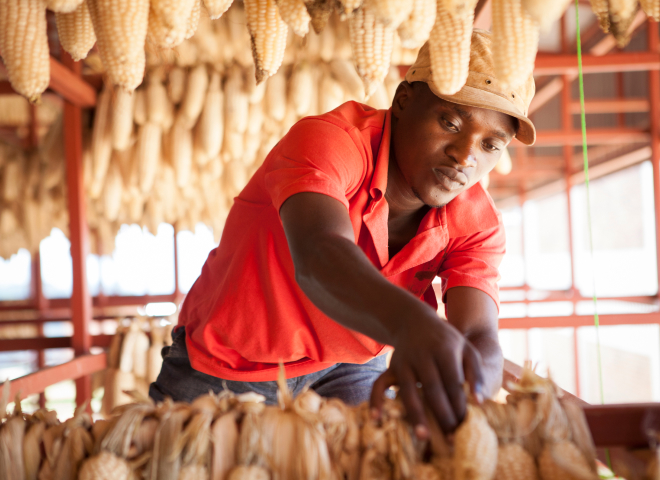
Some of the successes among many impactful research projects include work that explored a deceptively simple question: how do farmers learn about new agricultural technologies? Working with researchers from Michigan State University, IPA evaluated whether social networks could help sorghum farmers adopt microdosing, a technique using small, targeted amounts of fertilizer to maximize yields in poor soils.
The research involved mapping social networks across villages, then targeting the microdosing intervention based on farmers' connections to others. On the supply side, the team developed what would become an impactful scalable innovation: village input fairs organized during the post-harvest period led to significant farmer demand for and usage of inputs such as seeds and fertilizers. The fairs are scaling across Mali, Ghana, Senegal, and Côte d'Ivoire.
From 2015, the security situation began to deteriorate in the country, making fieldwork increasingly dangerous. COVID-19 in 2020 added new health risks and movement restrictions. The IPA team adapted: some projects shifted to phone-based data collection, and when rural telephone networks were disrupted, field supervisors worked with local communities, NGOs, and government ministries to develop new protocols. Enumerators coordinated with Ministries of Health and the Territorial Administration, Decentralization, and Security (MATDS), to get approval to enter villages.These field protocols balanced safety with research continuity, setting new standards for operating in conflict-affected areas.
This persistence enabled completion of a large-scale evaluation of a graduation-style program designed to help ultra-poor households escape poverty. The research, recently published in the Journal of Development Economics, established a new pathway for understanding how ultra-poor interventions could create lasting change.
Beyond poverty alleviation research, a family planning mass media campaign evaluated by IPA was adopted nationally by the Burkina Faso government in 2019. The campaign reached an estimated 80 percent of the population, leading to an additional 225,000 women using contraception. In another example, research on a locally produced mosquito repellent showed households widely used it—whether purchased or received for free—offering an effective way to reduce malaria incidence.
Alongside its research and policy impact, the office also played an important role in building local research capacity. Through initiatives like the Research Collaboration Initiative, young academics gained hands-on experience with rigorous field methods.
"What began as an internship became a launching pad for my professional career as an independent researcher. IPA's support came at a pivotal moment in my academic journey," said Dr. Issoufou Ouedraogo, who completed his PhD in Applied Economics at Norbert Zongo University after interning with IPA in 2022.
The People and Partnerships
Maud Amon-Tanoh, Country Director for Francophone West Africa, reflects on what made IPA Burkina Faso special:
"When I visited the office, I was amazed by how welcoming the people are—the culture, the hospitality. The team had that same warmth and resilience."
She emphasizes the depth of partnerships built over the years:
"The collaboration with ministries, with organizations like UNICEF and Development Media International (DMI)—these relationships were built on years of trust and mutual respect."
“IPA in Burkina Faso represented an important partner for us. We began working together around 2016 and conducted three major studies together. IPA helped us strengthen our capacity to conduct randomized trials. The team consistently demonstrated attention to detail and the ability to solve problems pragmatically when challenges arose in the field,” said Bassirou Kagone, Country Director, DMI.
For Adama Sankoudouma, a Senior Research Associate with IPA Burkina Faso, the experience at the Burkina Faso office reinforced a core conviction: "My time with IPA showed me how scientific rigor can be consistently put at the service of public action. It strengthened my belief that research only has real value when it is useful, contextualized, and accessible—both to decision-makers and to local communities."
A Legacy That Endures
If the work was so successful, the team so dedicated, the partnerships so strong—why close?
"In a context where development financing is tightening, IPA is making thoughtful, strategic decisions about our geographic footprint to better deliver on our mission and drive real change," explains Claudia Casarotto, IPA's Chief Global Programs Officer.
While the Burkina Faso office is closing, its work continues. IPA's Francophone West Africa office in Côte d'Ivoire will carry forward regional initiatives. Partnerships with implementing partners, academic institutions, and national researchers remain active.
The evidence generated will continue informing policy and practice. The capacity built in young researchers endures. And government programs scaled from Burkina Faso research—like the family planning campaign—still deliver impact.
"We showed that evidence-based policy can survive conflict, adapt to crisis, and still maintain the rigor that makes it trustworthy," Adama reflects. The combination of local teams, committed partners, and rigorous research is the lasting legacy of IPA Burkina Faso.