

Unconditional Cash Transfers in Kenya
Programs designed to alleviate poverty often focus on delivering goods or services (e.g. productive assets, training, bed nets, etc.) or capital conditional on certain outcomes to poor households. While these types of programs may be effective in achieving specific goals, they do not provide poor households with the choice and flexibility of allocating resources to meet the needs they find most pressing. An alternative approach to delivering support in kind is to simply give money to poor households. However, this approach is sometimes received with skepticism, as there is no guarantee that money will be spent to achieve the specific impacts that donors desire. This evaluation will study what happens when poor families are given cash without any stipulations.
This study takes place in Kenya, a country at the forefront of the mobile money revolution. Since the launch of M-PESA, a mobile-phone based transfer service, in 2007, Kenya has become the country with most extensive retail payment network[1]. GiveDirectly is a non-profit organization that leverages the low costs of mobile money to deliver cash transfers to poor households, reducing the cost of delivery to only 10 percent of each donated dollar. Beneficiaries receive donated money on their SIM cards and can visit a local M-PESA agent to exchange the mobile credit for cash.
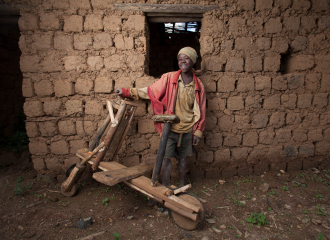
Households are eligible for the unconditional cash transfer program if they have homes constructed entirely from non-solid materials (mud, grass, etc). GiveDirectly has identified 1,250 eligible households in the Rarieda district of Kenya. Study villages in this district are randomly assigned to a treatment or pure comparison group. Within treatment villages, 500 eligible households are then randomly assigned to receive unconditional cash transfers. These households will then be compared to 500 control households in the same villages, which do not receive transfers. In addition, the 500 control households will be compared with 250 households in pure comparison villages to identify any spillover effects of the intervention. All study households receive a baseline survey before randomization.
Households receiving the cash transfers are randomly chosen to either receive a single lump sum transfer of 25,200 KSH (about USD 280), or monthly transfers for nine months with the same total value. In addition, to assess whether household expenses differ when money is transferred to the head male or female of the family, the gender of the transfer recipient is randomly selected.
Money is transferred to beneficiaries using Safaricom’s M-PESA mobile payment system—sending money from the GiveDirectly account to the recipients’ SIM cards. Recipients, who are required to register with M-PESA, receive a text message when funds are transferred and can then visit a local M-PESA agent to transfer mobile credit to the agent’s phone in exchange for cash. Most households in the sample are within a 30-45 minute walking distance to an M-PESA agent. Households in the program without mobile phones are given SIM cards to allow them to redeem money. A follow-up survey one year after the first transfers will collect data on income sources, investment, consumption, food security, school enrollment of children, and mental and physical health. These surveys will be complemented by the collection of salivary cortisol levels to measure the impact of unconditional cash transfers on stress.
Results forthcoming
For additional information, view GiveDirectly’s Evidence page.
[1] Klein, Michael, and Colin Mayer. May 2011. “Mobile Banking and Financial Inclusion: The regulatory lessons” World Bank Policy Research Working Paper 5664.
- Countries: Kenya
- Sectors: Microfinance & Enterprise
- Policy Areas: Cash Transfers, Technology Access (ICT)
Featured Country
